
MINIATURE LANDSCAPE CARE
[The following is excerpted from my book, The Pruning Book, available, signed, directly from me as well as from the usual sources.]
Refreshening Soil
Suppose you’ve just created a bonsai plant, or you’ve just bought one, or been gifted one: Does the plant need further pruning? Most assuredly, yes! Bonsai need regular pruning both above and below ground throughout their life. The frequency of pruning depends on just how fast the particular kind of tree or bush grows, the size of the pot, and the growing conditions.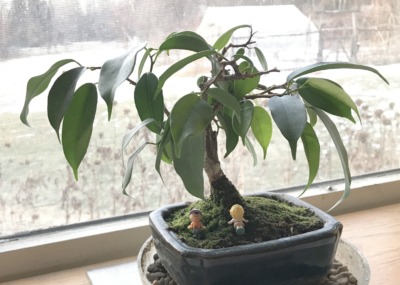
Roots eventually fill the soil in a small, bonsai pot, so root-pruning is needed to make room for fresh soil. Root-prune deciduous bonsai in early spring or late autumn, evergreen bonsai in early spring or late summer.
The way to root prune bonsai is to first lift the plant out of its pot, then cut the root ball back all around and underneath with scissors or pruning shear. (Not one you like to keep super sharp because those blades will encounter some soil particles while cutting.)
After teasing roots on the outside of the ball outwards, add enough soil to the bottom of the plant’s container to bring the ground surface back to its original height. Return the plant to its container and pack new soil in among the roots. Using a stick — a chopstick is culturally appropriate — to pack down the soil makes sure no large air spaces are left in which the roots would dry out.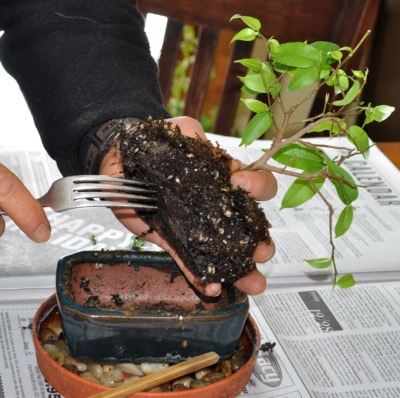
Next, the Stems
The time to prune the top portion of a bonsai plant is now, while it is dormant, and again while it is actively growing. Bonsai plants respond to pruning the same as do full-size plants. Pinch the tips of shoots where you want to slow growth. Cut stems back to their origin where no or minimal regrowth is wanted — where, for example, too many stems are crowded too near to each other. Shorten a stem where you want the remaining portion to branch. Rub off buds or cut stems back to their origins where growth is not wanted.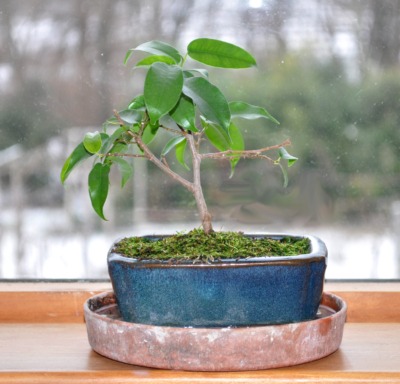
Pinch back expanding new growth of junipers, and candles of pines and spruces, wherever you want these plants to be more bushy.
Because you view bonsai at such close range, you’ll want to make all pruning cuts especially clean, more so than on full-size plants. So, to avoid damaging remaining leaves when you shorten expanding growth on spruce, for example, reach within a tuft of foliage with a pair of tweezers to tweak off all but a few new leaves. A small, pointed pruning shears works well on stems.
Then again — and this is only for bonsai, not for full-sized plants — stubs of older stems lend a wizened look to a Lilliputian tree.
And Finally, the Leaves
Some bonsai benefit from having all their leaves pruned off just after they fully expand. Timed correctly, such leaf pruning forces a second flush of leaves which are smaller, and, hence, better proportioned to the size of the plant. You can get two seasons of development in one season with this trick. As an added benefit, that second flush of leaves often offers more dramatic autumn color than the first flush would have.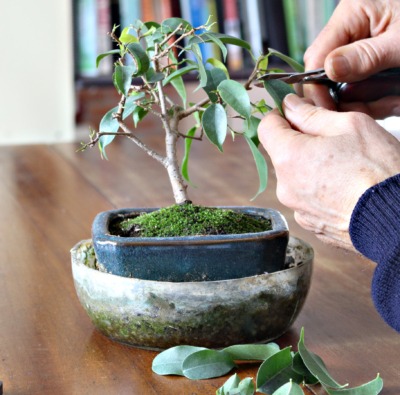
Leaf pruning is not the thing for a plant that has been weakened by disease or insect pests, or show off-color leaves from starvation. Such plants need, besides correction of whatever is causing weakness, all the leaves they can grow to sustain them.
On some trees, such as maples and elms, you can leaf-prune twice each season, as the first and second flush of leaves fully expand. With trees such as gingko, beech, and oak, timing is critical to get even a second flush of leaves. If there’s any chance of injuring buds at the bases of the leaf stalks, just cut off most of each leaf with a scissors. The stalk will come off, perhaps needing some help from you, as new leaves appear.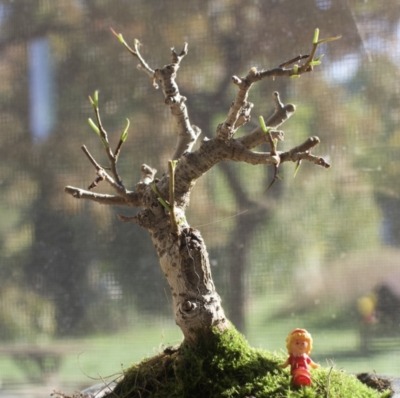
Leaf pruning is not for every bonsai. Don’t do it on evergreens or on fruiting bonsai that are bearing fruit. And leaf-pruning is stressful, so avoid this practice on any tree that is weak or sick.
The rigorous root and shoot pruning needed for bonsai is itself weakening, which is a good reason to take extra care in giving bonsai perfect growing conditions in every other respect. This means water and fertilizer, as needed, as well as good light. Most bonsai are dwarfed, cold-hardy trees and, as such, like to be kept as cool as possible this time of year.
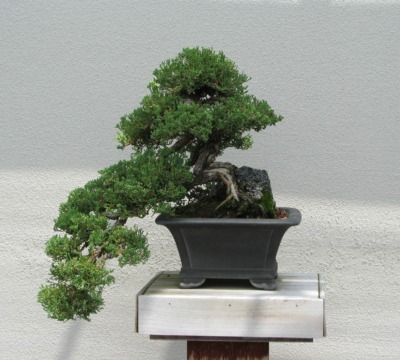
Bonsai juniper, Longwood Gardens



Hi Lee –
I’ve been keeping bonsai for 4 decades! Do you make yr own bonsai soil? I’ve bought the 3 separate bags of lava rock, Acadama, & pumice, & always added to that mix, an equal amt of compost, even ‘tho they say just planting them in those rocks is good enough, but I don’r believe it. Mine are all outside under snow, dormant.
Yes. I use the same potting soil for everything except cactii and succulents. Those rocks offer nothing nutritionally to the plant. If you did use them, you’d have to occasionally water with fertilizer added. My potting mix has peat, compost, garden soil, and perlite, along with some perlite.