
ALL FOR A SLICE OF PIE
The Real Thing
This time of year, a slice of Key lime pie is the next best thing to walking along a beach in the Florida Keys. Okay, not the next best thing, but good eating anyway. Hold on a minute, though, before beginning your gustatory journey; the supermarket is not the place to begin.
What you are most likely to get at any market is a Persian lime (Citrus × latifolia), a hybrid of Key lime and lemon), and this kind of lime lacks the unique and potent aroma of a genuine Key lime (Citrus × aurantiifolia). Persian lime is more cold-hardy and less seedy than Key lime, and has a longer shelf life. Even commercial lime pies are sometimes made with Persian limes, one reason why a pie from a bakery or a slice in a restaurant might miss the mark in flavor.
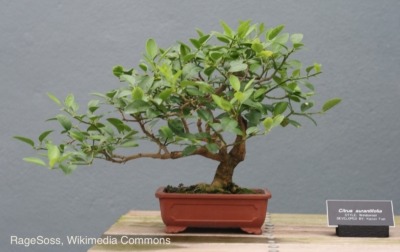
Bonsai Key lime tree
You probably now suspect — and rightly so — that I’m going to suggest that you grow your own Key limes. Do it, but watch out that what you get is a Key lime plant, because most lime plants sold also are Persian limes, usually the variety Bearss.
The Search is On, and Another Lime
To find your Key lime plant, you should know its aliases. It’s also been called Mexican lime and West Indian lime.
None of these aliases, even the name Key lime, is well-founded, because Key limes are native to India and Malaysia. Sure, they were planted in south Florida, but that was only after being carried to North Africa by Arabs, then to the Mideast and Mediterranean by the Crusaders, and then to the Caribbean, where the plants naturalized, by the Conquistadors. Key limes were widely planted in Florida only after a hurricane wiped out pineapples there in 1906; lime fruits pickled in salt water were shipped north where they were a popular snack for school children. (That doesn’t sound very appetizing to me.)
Another hurricane, this one in 1926, wiped out many of the Key lime trees in Florida, and the industry has faltered ever since. If your slice of pie has indeed been made with real Key limes, the fruit most likely was grown in the Caribbean.
Unless, of course, you grow Key lime yourself — not a difficult feat at all once you get a plant. I once grew Key lime but was disappointed with its production. Not that it was hard to grow.
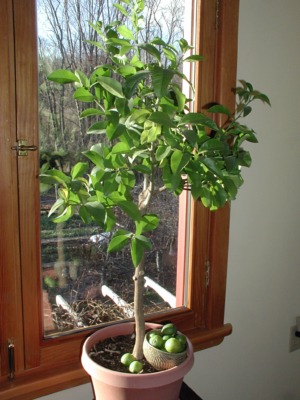
My Key lime tree
The lime I’m looking for now is the finger lime (Citrus australasica). This lime is unique in that its small, elongated fruits are filled with sprightly flavored juicy vesicles, each one separate like small beads which give rise to its sometimes being called “lime caviar.”
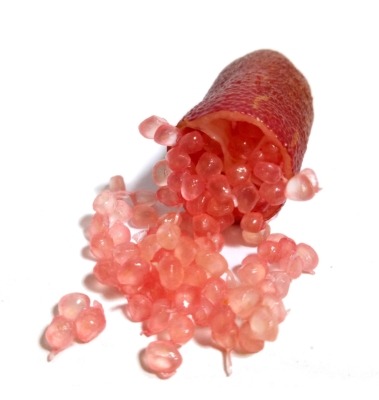
Red finger lime
Finger limes are evidently causing quite a buzz of their own. Australia’s Commonwealth Scientific and Industrial Research Organisation (CSIRO) has livened things up by breeding varieties of various colors, sizes, and shapes, the colors also carrying over to the lime caviar within. 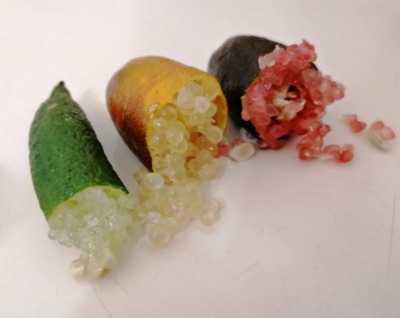 It’s also been bred with Key limes to produce some unique varieties.
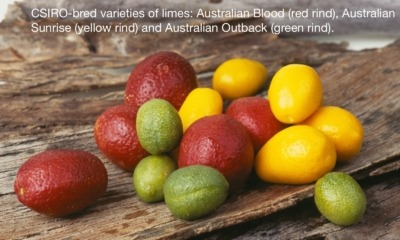
Selection of native lime hybrids
Grow It!
If you ever lay hands on a fresh Key lime fruit, you could start a plant by rinsing the seeds and then immediately sowing them. It’s a satisfying (and inexpensive) way to get a plant, but you will have to wait longer — five to ten years, depending on growing conditions — for your first pie with this method than buying a plant. Come upon a Key lime tree somewhere, and you could also make new ones by taking cuttings or, if the tree wasn’t grafted, digging root sprouts. Trees grafted or from cuttings typically fruit within two to three years.
Once you have a tree, all you need is a flowerpot filled with any standard potting mix. With annual pruning of both stems and roots, you could keep the plant as small as a couple of feet high. Of course, larger plants yield more fruits and more pies.
Key lime revels in heat. Keep the tree in the sunniest window you have in winter, then move it outdoors to a sunny location once warm weather settles in in spring. Key lime is among the most frost sensitive of citrus, so move it outdoors early summer, then indoors in early fall, well before any hint of frost threatens at either end of the growing season.
Expect your first harvest within a couple of years of planting the tree. Allow the fruit to turn pale green or yellowish for full flavor, then squeeze away for your pie. Too many fruits at once? Store them in a cool room in a plastic bag or under water, or make some juice, jam, jelly, or marmalade. And don’t waste the flavorful peel: recreate a popular sweetmeat of Java by chopping the peel with coconut and milk.



what an interesting fruit to propagate in our climate. I am from the west Indies and we grew lime tree, not sure any were key limes. I will try to bring back some seeds to grow here in rockland County. Thank you ❤️
Dear Lee. I wish I could send you a photo of my key lime tree. It is sitting in the glass door and has 5 huge yellow lemons. They are the size of oranges. I am trying to decide what to do with these special fruits.The plant was given to me by my children for mother’s day a year ago.
On fish? Mixed into a drink? Pie?
Hi Lee,
Can you recommend some good sources to purchase the genuine key lime tree?
Thanks,
Scott
Logee’s Greenhouses or One Green World.