
MELANCHOLY APPEARANCE?
The following is adapted from my book, The Ever Curious Gardener: Using a Little Natural Science for a Lot Better Garden, available from the usual outlets or, signed, from me (www.leereich.com/books).
Growing Down
Why are these trees so sad — even with pink or white blossoms cheering up their branches? But of course: they’re not really sad, they’re just weeping.
So why are these trees weeping, then, even if they are not sad?
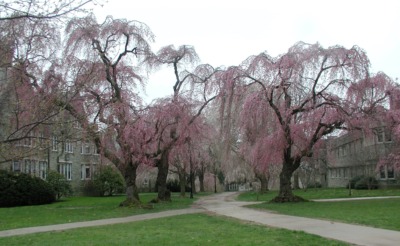
They weep because they want to grow down. Instead of young stems reaching for the sky, as is the case with most trees, young stems of weeping trees toy only briefly with skyward growth before arching gracefully down towards the earth. Some plants begin to weep in earnest only after they get some age to them.
Weepy Beginnings
A weeping tree may have begun life as a chance seedling whose quirky arrangement of genes directs its stems to weep. Some such plants, although woody, could hardly be called trees. A weeping kind of goat willow, for example, makes a kind of billowing groundcover.
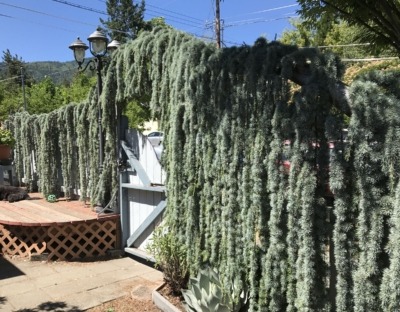
Weeping Atlas Cedar
Or, a weeping tree may have begun life with normal stature — until some cells in some branch of that tree underwent a slight mutation to a weeping habit. Perhaps the mutation was due to the effect of sunlight or temperature, perhaps the mutation was spontaneous. At any rate, all new stems and branches originating from those changed cells weep.
Now let’s make whole new plants from that weeping seedling or those weeping branches. If the weeping plant is one that roots easily from cuttings, you could just clip off a branch, stick it in the ground or some potting soil, and nurture it along. A cutting won’t do, however, if the plant is one of those weeping plants — like that weeping goat willow — that just creeps along the ground. What you really want is a weeping tree.
To create a weeping tree out of ground hugging weeper, or one that doesn’t root readily from cuttings, you graft a stem or bud from the weeping plant atop a length of trunk, typically five or six feet high, of some upright growing plant. As with any graft, success is possible only if the trunk section is closely related to the weeping stem piece. Your weeping cherry, for example, was created by grafting a stem from a weeping cherry atop a five or six foot trunk of some upright cherry. The graft juncture is usually obvious throughout the life of the tree.
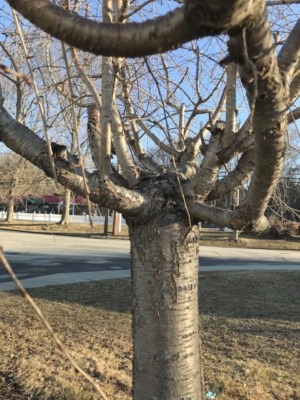
Graft union of old weeping cherry
Change of Habit
Sometimes a branch of a weeping tree will all of a sudden start reaching skyward. (Talk about a wacky looking tree!) That stem could have arisen from a bud below where the graft was made. Or a branch mutation might have retained some nonweeping cells that occasionally express themselves in upright branches. In either case, just lop any nonweeping stems right back to its origin.
Even looking beyond the ubiquitous weeping cherries and crabapples, weeping trees are not all that rare. Japanese dogwood is a lovely tree whose white blossoms unfold after the leaves are fully out; the variety Elizabeth has somewhat weepy upper branches. A weeping form of Katsuratree presents a waterfall of bluish green leaves.
For a weeping evergreen, few are more graceful than Sargent hemlock. Or more odd than a weeping form of giant sequoia, whose leading stem pushes skyward in fits and starts, zigging and zagging and dipping along the way but always remaining clothed in a shaggy mane of droopy branches.
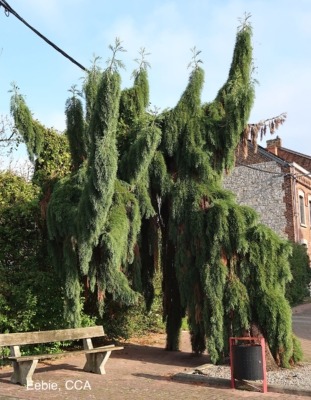
Weeping Giant Sequoia
Many yards benefit from some weeping tree, whether it’s a willow along a streambank, a weeping cherry lending grace and tranquility to a front lawn, or a weeping beech providing a hideaway for kids. 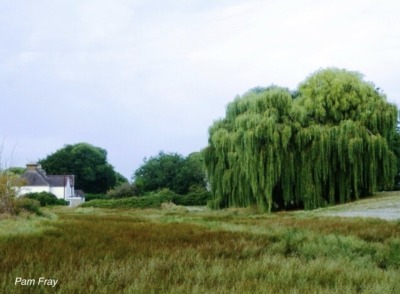
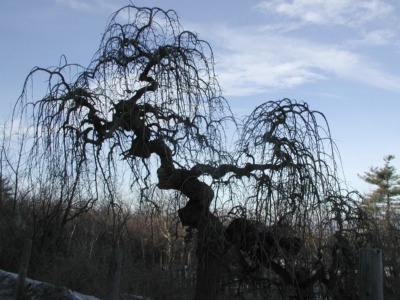
Weeping mulberry
The only caution with weeping trees is not to plant too many, which might be more than one — otherwise, the scene can look sad indeed.
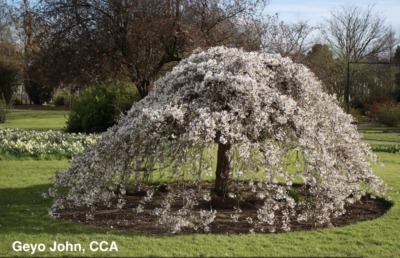
Weeping cherry



Thanks for the smiles. I love my weeping Katsura!