Japanese beetles

JAPANESE & FLEA BEETLES, & LAISSEZ-FAIRE

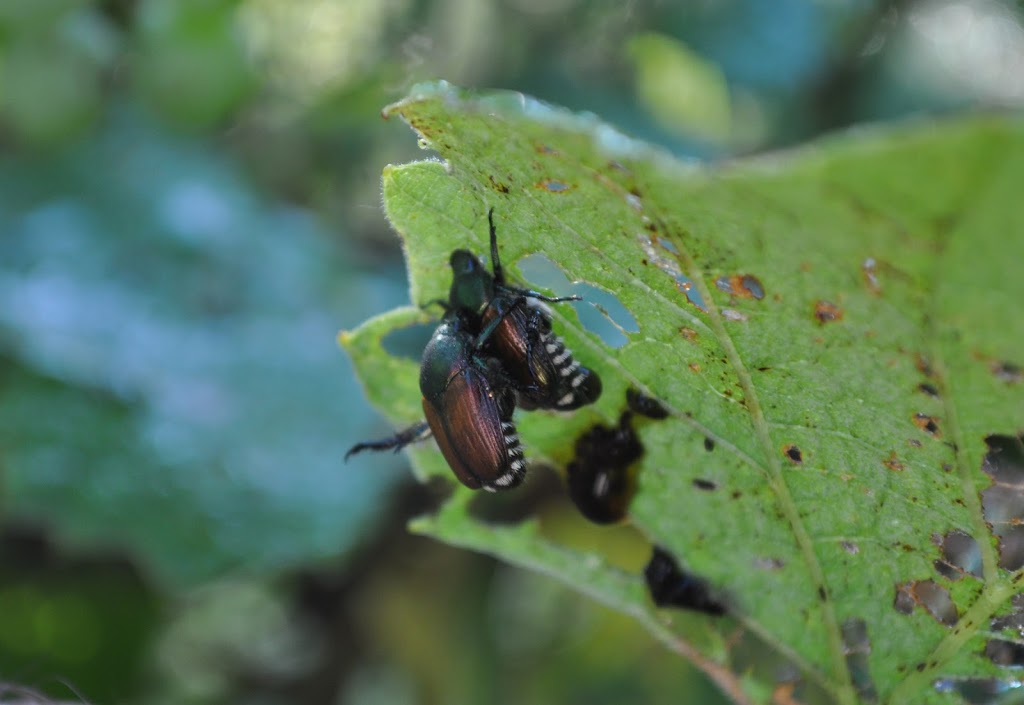
I grabbed the dustbuster as I walked out to the garden this morning, hoping to inaugurate a new era in Japanese beetle control, who began their summer feeding early this month. The dustbuster was ineffective, the beetles passively dropping from any leaf as soon as the nozzle came within a few inches. Even beetles caught in flagrante delicto decoupled and dropped.
This year’s approach to Japanese beetle control will be laissez-faire. Spraying a chemical insecticide like Sevin is too disruptive to the ecosystem. Most organic insecticides, such as neem oil and pyrethrum, are either of limited effectiveness or require too frequent reapplication. And anyway, the beetles attack too many different kinds of plants to make spraying feasible; I’ve got over a dozen varieties of grapes, a half dozen varieties of roses, many varieties of filberts, and a dozen hardy kiwi vines scattered all over the place, and these are just a few of the beetles’ favorites in my garden.
In past years, I’ve put traps a couple of hundred feet apart at either end of the property. Each morning, the catch bags were stuffed full of beetles. But many of those trapped beetles would not have been on-site were it not for the allure (from sexual and feeding attractants) of the traps. The traps seem to work best when only a few Japanese beetles are in the area.
Japanese beetles can get sick from a fungus that attacks them while they spend late summer to late spring in the soil as white, C-shaped grubs. You can purchase the disease, milky spore disease, with which to infect them. Problem is that the disease is of limited effectiveness: Not enough grubs sicken and die and, even if effective, beetles emerging in summer can fly over from neighbors’ untreated yards.
I’ll probably do a little handpicking, knocking or dropping beetles in early morning, while they are still drowsy, into soapy water, from which an escape is too slippery. Hand to hand combat is satisfying and surely effective (for the ones killed, at least). Japanese beetles emit an aroma that attracts more beetles, so hand to hand combat is also intellectually satisfying in the knowledge that each beetle killed means fewer new ones attracted.
The laissez-faire approach has its merits. Plants tolerate a certain amount of defoliation, the remaining greenery ratcheting up photosynthesis to make up for leaf loss.  And if the plants can just hang on for a few weeks, the beetles then begin their exit anyway, their attention turning to laying of eggs in the ground to hatch into grubs for next year’s beetles. Well watered, lush lawns provide ideal conditions for egg laying and grub development; ‘nuff said.
———————————————
Flea beetles, which have peppered the eggplants’ leaves full of holes, will not be emulating Japanese beetles and exiting stage left anytime soon. If you grow eggplants, you have flea beetles, except for perhaps the first year or two in a new garden, before the pests have found your site. Other favorites on flea beetles’ menu are radishes, arugula, and turnips.
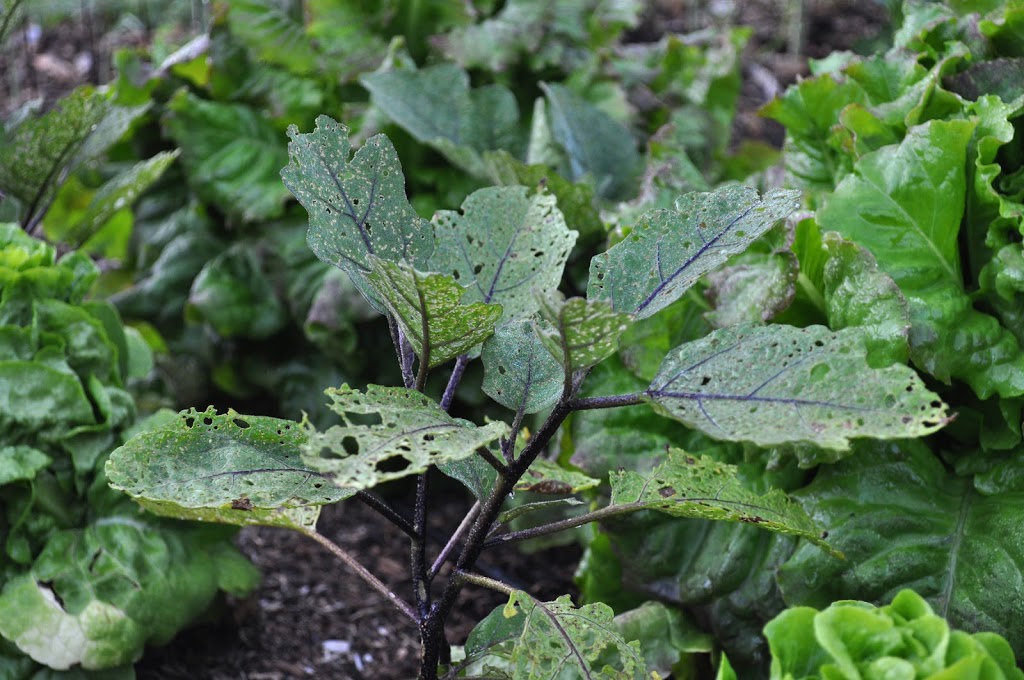
Flea beetles, in contrast to Japanese beetles, can be feasibly thwarted. A dustbuster, in this case, can be effective if used frequently enough. A thick mulch might interfere with their emergence from the soil. Fine mesh fabrics, — “floating row covers” — act as barriers although I like to be able to see my plants and the cover has to be removed during bloom to allow for pollination of eggplants.
Mostly, flea beetles are a concern with young seedlings, which can be killed, and for commercial growers, because customers don’t like to buy hole-y vegetables. 
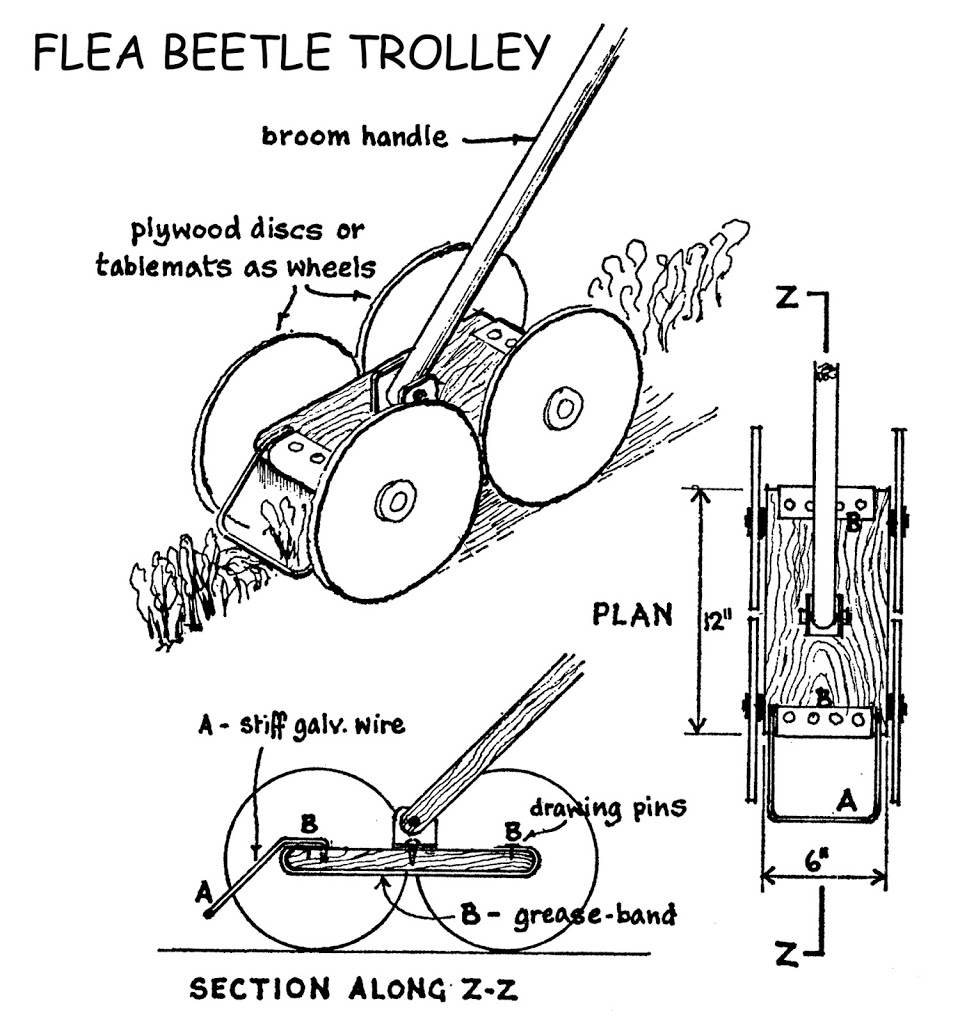
Flea beetles hop away when disturbed and my favorite way to do them in is with the “flea beetle trolley” described on page 144 of Lawrence D. Hill’s Grow Your own Vegetables (Faber and Faber, 1971). Quoting Mr. Hill, “A wire in front disturbs the beetles which jump up and stick to the greaseband [flypaper or paper coated with Tangletrap would also work well]. The large wheels prevent sideways jumping.” The trolley works best on masses of leaves of small plants, such as radishes or arugula, rather than on widely spaced, larger plants with tiers of leaves.
Hot pepper may repel flea beetles. Research suggests that commercial “hot pepper wax” reduced flea beetle damage by about a half, so it may be worth a try.
I might take the laissez-faire approach to flea beetles as well as Japanese beetles. I’ll keep in mind that established plants tolerate 10 to 30% loss of leaf area without ill effect.
——————————–
Sometimes it pays to look closely at your garden plants; sometimes it doesn’t. My general tack with plant pests starts with offering my plants the best possible growing conditions. This means soil that drains adequately and is enriched with plenty of compost and other organic materials to provide nutrients and a friendly microbial environment. It means providing water, as needed. And it means allowing for adequate plant spacing and light. Still, it’s a wide world of insects, fungi, bacteria, and viruses out there, as well as capricious weather, so there’s no reason to expect perfection from each leaf and fruit. Much damage is nothing more than cosmetic and is tolerated by plants. 
One nicety of home-grown fruits and vegetables is that there’s no monetary profit needing to be optimized. So some amount of damage is, and also should be, tolerated by us home gardeners.
——————————–
EASY CHERRIES AND A GREEN ROOF

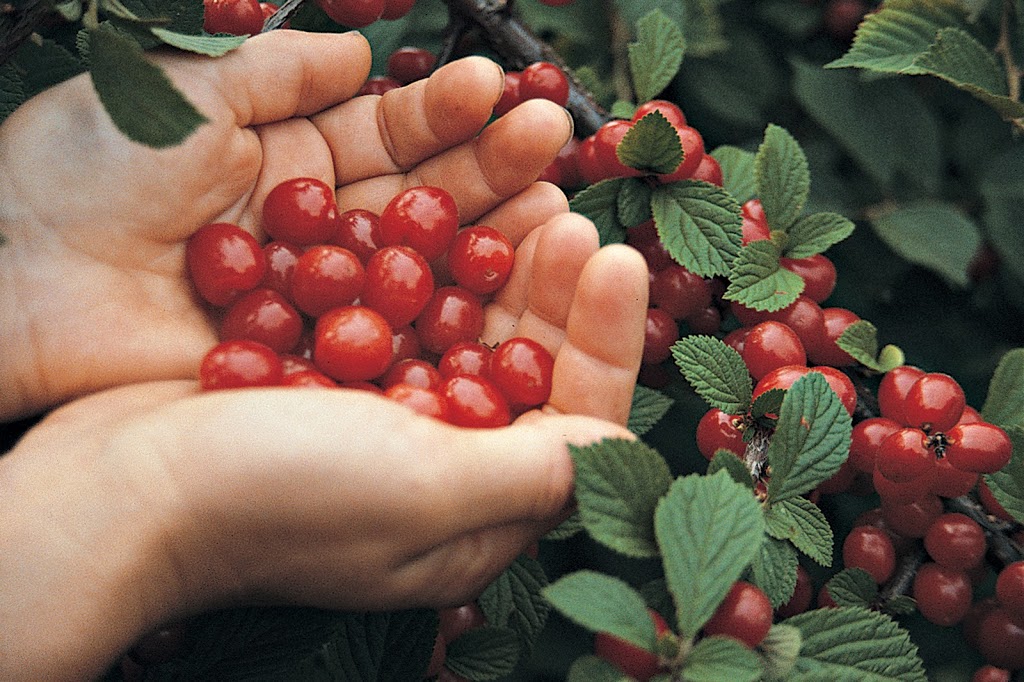
My Nanking cherries (Prunus tomentosa) made a lot of people happy this year. Joy was first spread in early April as thousands of pinkish white flowers burst open along the stems, enough to almost completely hide the stems. Passers-by enjoyed the hedge of plants, which run along the driveway; some people even asked about the name of the plant.
In early June, the blossoms morphed into small, red cherries, oodles and oodles of them. Now, the end of June as I write, just a few cherries still cling to the stems. Throughout the month of June, though, friends, strangers, relatives, birds, chipmunks, and creatures unseen feasted on the abundance.
Nanking cherries are admittedly small and somewhat hard to harvest because they cling closely to the stems on short stalks, but these two deficiencies are far offset by the care the plants need. Almost none! Every few years, I whack back some stems that become decrepit or send the plant high or wide out of bounds.. And I usually spread wood chips or leaves beneath the bushes as mulch to suppress weeds and conserve soil moisture. But neither of these minor tasks is absolutely necessary.
Perhaps the most amazing thing about Nanking cherries is that there are no improved varieties. That is, they are all random seedlings, each a genetic individual. Yet they all taste good, ranging in flavor and texture, depending on the individual, from almost sweet to sour cherry. (Compare this to wild apples, which pretty much all taste bad; the good-tasting apples that we have are the result of hundreds of years of selection and breeding.) Nanking cherry fruits are small, as are the wild cherries from which cultivated cherries are derived.
One of my bushes yields cherries that are slightly larger, slightly firmer and, hence, easier to harvest, and slightly sweeter than my other 10 or so bushes. Seeds from that bush didn’t get spit on the ground; I collected them for planting. Nanking cherry bushes bear fruit within a couple of years and repeated selection of plants bearing the best fruits could result in bigger and better fruits. Improvements might also come from widening the genetic input with pollen from a wider range of Nanking cherry individuals and even some related species, such as sweet cherry. The combination of Nanking cherry’s tolerance to winter cold, late spring frosts, and insect and disease pests and sweet cherry’s fruit size, sweeter flavor, and firmness would make a plant that was easy to grow with even tastier fruits.
I’ll report back in years to come. For now, run-of-the-mill Nanking cherry is well worth growing and another perfect fruit for ambulant consumption on the way to the front door or to the mailbox at the end of the driveway.
—————————————————–
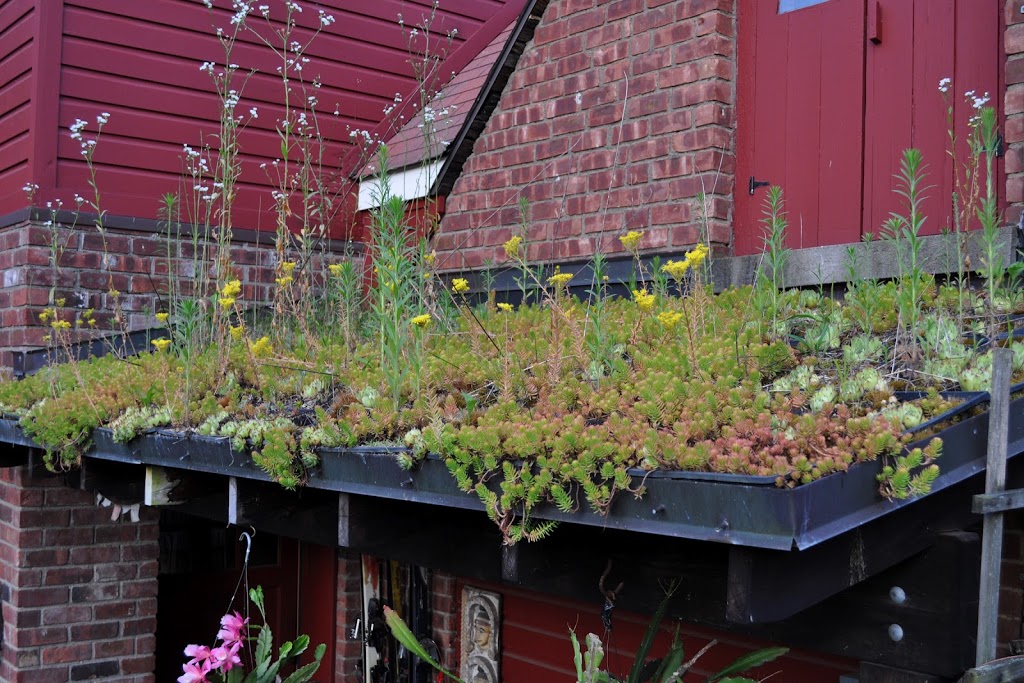
I have a good excuse for the weediness of one of my gardens: It’s on a roof, not an area I frequently walk past with the opportunity to pull a few weeds. I would have to get a ladder and, because this garden is not to be walked on,  reach in as far as possible. I don’t weed it.
This garden is a “green roof” covering a front porch. Green roofs absorb rainfall and the sun’s heat, insulate whatever is below, and look — well — green and alive. The last reason prompted my roof planting about ten years ago.
Original hens-and-chicks laid on roof
But first I had to build the porch roof. Construction was standard — oak posts and crossbeam with 2 by 8 joists covered by 1 by 6 planks — except for the covering of rubber roofing bonded to copper flashing provided with weep holes at the lower end. Planting was begun the year before with hens and chicks (Sempervivum spp.) in seedling flats filled with a mix of equal parts peat moss and calcined montmorillonite clay (the latter also known as “kitty litter). That spring I snuggled the flats next to each other on the roof. Setting flats on the roof intact would, and did, prevent rainfall from washing the planting mix and plants down the slope, the angle of which was determined mostly by aesthetics. I wanted the top of the roof just visible from the driveway.
The goal was for the hens and chicks to make more chicks, and those chicks to make even more chicks, spreading to make a dense, blue-green mat over the surface and draping over the lower eave. They didn’t spread thoroughly or fast enough.
Angelina now filling in the roof
It takes a tough plant to survive and grow on this roof. The soil mix is only a couple of inches deep so plant roots are exposed to the full brunt of winter cold and summer heat, and the roof gets only natural rainfall. Because hens and chicks weren’t fully up to the task, I started planting other succulents to fill in bare areas amongst the hens and chicks.
Over the years, the most successful of these plants has been Sedum rupestre ‘Angelina’. Not only does ‘Angelina’ survive and grow under the austere conditions, but she also looks pretty year ‘round. Right now, the plant is a trailing mat of fleshy, pointed, pale green leaves up through which push foot-high shoots capped with clusters of yellow flowers. In fall and winter, the leaves take on an amber hue. The plants root very easily to furnish new ones to fill in the few remaining bare spots. I pluck off pieces of shoots and toss them back onto the roof to eventually root and spread. Very convenient. 
———————————————
It’s hard to imagine how weeds have gotten onto my green roof, let alone survive. Birds and wind, no doubt, got the plants there. The weeds include fleabanes and some grasses. Some people tell me that these “weeds” look pretty up on the roof, so maybe they’re not weeds. The fleabanes, now in bloom, hold their white, daisy-like flowers high above those of ‘Angelina’. And, if nothing else, both weeds . . . whoops, I mean plants . . . hold the soil in place as ‘Angelina’ continues to spread.
———————————————

SEAKALE, CHUFA, OCA

I’m often questioned, “So what are you growing that’s particularly interesting this year.” It’s a tough question to answer because following the growth of even common plants is interesting year after year, watching how they respond to the vagaries of each year’s weather and pests, changing growing techniques, and other influences. Still, a few plants always elicit a, “You’re growing what?”

Such as, for instance, three edibles: seakale, chufa, and oca. Let’s start with the seakale (Crambe maritima). This plant had been growing at the edge of one of my flower beds for many years but died last year. I never did try eating the plant but had earned a permanent place in the flower bed for its gray-green leaves and attractive sprays of 4-petalled white flowers. Those two characteristics would also rightly land the plant in the cabbage family.

Like cabbage, seakale is edible; unlike cabbage, it needs special treatment before being rendered so. That special treatment is blanching, or shielding the emerging leaves from light to make them more tender and mild-tasting. My plant always seemed too weak to endure such treatment so the plant has been enjoyed only for its good looks. This year, though, I have raised a few seedlings, two of which I planted in the rich soil of the vegetable garden and should be strong enough for a couple of weeks of blanching early next season.

Seakale shoots are too tender for transport so you’ll probably never see them for sale. They were popular in gardens of 200 years ago, though — Thomas Jefferson’s, for one. If flavor turns out to be the reason the plant fell out of favor, I’ll just continue to grow it amongst the flowers.
—————————————————–

Chufa (Cyperus esculentus) is another edible making a return engagement to my garden. This one makes knowledgeable gardener’s raise their eyebrows because it’s very closely related to a pernicious weed, yellow nutsedge. They’re both the same genus and species. I received tubers from J. L. Hudson, Seedsman (http://www.jlhudsonseeds.net/) who claims that the particular selection that they offer does not become weedy; I confirm that claim.

Chufa’s edible portion are the below ground, almond-sized tubers that have a texture an flavor reminiscent of coconut. So you can grow your own “coconut” even where winter temperatures plunge below zero degrees Fahrenheit. Above ground, chufa (and yellow nutsedge) have a grassy appearance except that rolling one of the clumping leaves between your thumb and index finger reveals the triangular cross-section characteristic of sedges. Grass blades are flat.

The main problem in growing chufa is separating the harvested tubers from the soil. Gravel or small stones are about the same size, and a lot harder on your teeth should you accidentally bite into one in a batch of chufa. My plan is to hose down each harvested clump well and then to stir the tubers in water just enough to let anything with the density of stone settle out first. And chew carefully.
—————————————————-

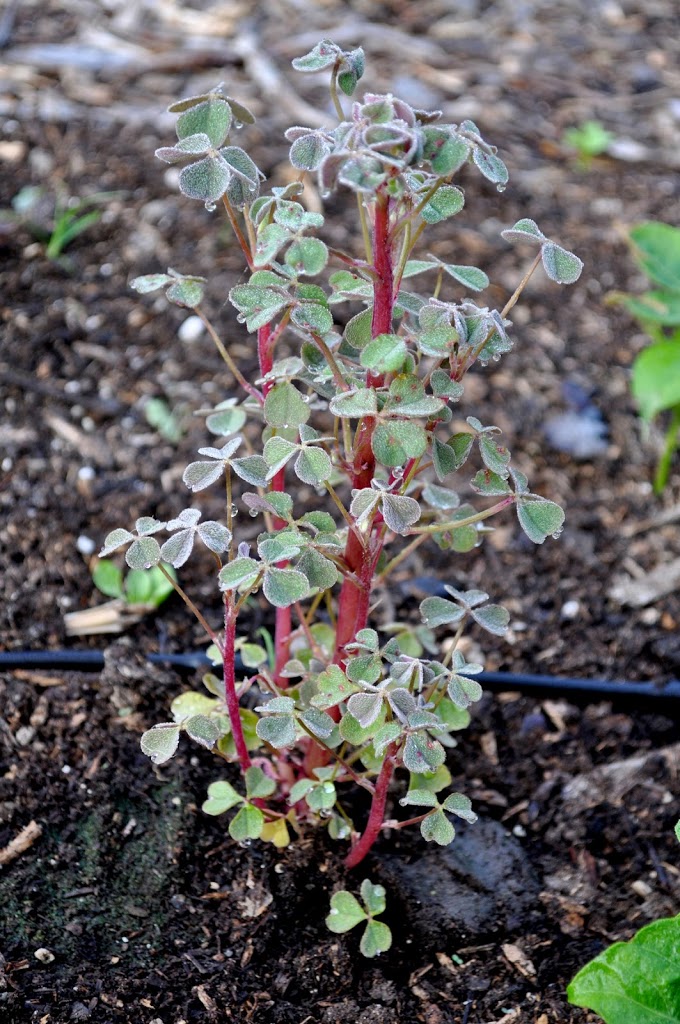
Oca (Oxalis tuberosa) is perhaps the most interesting new plant in my garden, among edibles, at least. It’s related to one of my worst garden weeds, creeping wood-sorrel (O. corniculata). It’s a staple food of the Andean highlands and an iffy crop, around here at least.

The limitations to growing oca are that it needs a long season and it forms tubers only when days grow short (at which time cold weather is likely to kill stems and leaves). On the other hand, the plant has been cultivated for centuries so there are many varieties. New Zealanders have been enjoying and growing oca (which there are called yams) for about 150 years and their varieties are more likely suited here.

I don’t know the provenance of the oca tuber I planted so it could just take up garden space the whole season then die back leaving nothing of value underground. My plan is to keep it warm in autumn beneath a cover of clear plastic, which would be needed even for the most adapted varieties.

And then there’s the flavor. Many varieties, many flavors, from tart to sweet. Oca is used like potatoes and also eaten raw. In the Andes, super-tart varieties are freeze-dried by being left outside on the ground on hot, sunny days and cold, freezing nights. Stamping on defrosting tubers speeds water removal. Interesting, yes?
—————————————————–

Seakale, chufa, and oca are among perennial vegetables that, once planted, come back year after year of their own accord. Others include black salsify, groundnut, Jerusalem artichoke, ramps, skirret, Welsh onion, and, of course, asparagus. For more about perennial vegetables, see Perennial Vegetables: From Artichokes to Zuiki Taro, A Gardener’s Guide to Over 100 Delicious and Easy to Grow Edibles by Eric Toensmeier
—————————————————–
FLOWER BED MAKEOVER

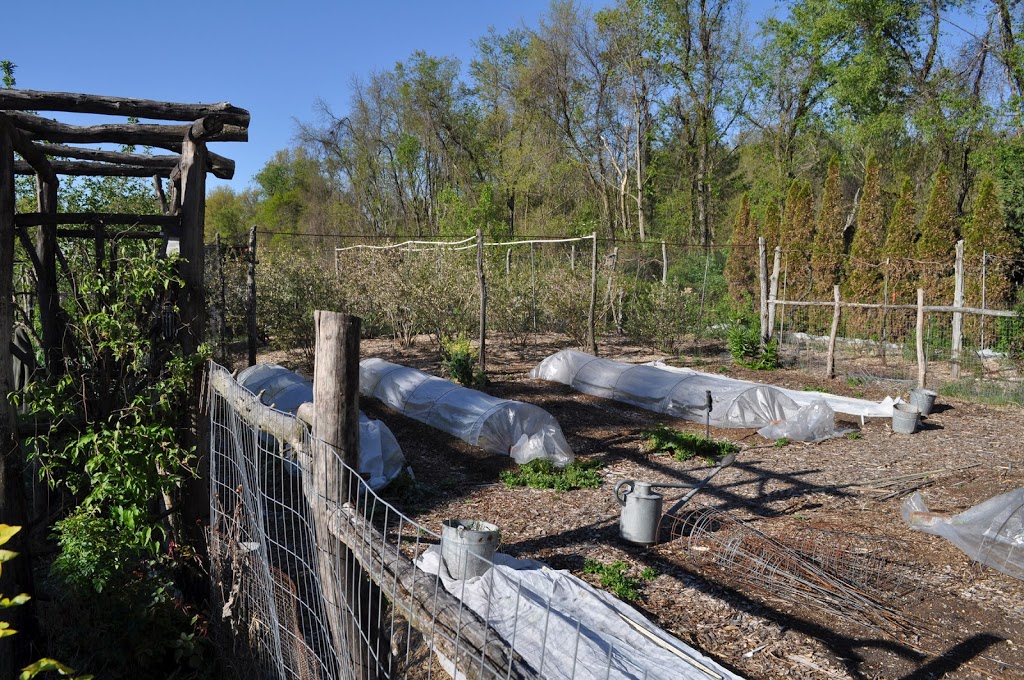
A recent visit to the garden of Margaret Roach (http://awaytogarden.com/) inspired me to makeover a flower bed. Margaret’s garden is all ornamental, a sometimes lively, sometimes subdued interplay of plant shapes with leaf textures and spots of color. My garden is mostly for eating, although I balance that functionality with rustic arbors, shrubbery (some of it edible and ornamental), and interplay of sight lines. And I do have a couple of flower beds.

My flower bed 10 years ago.
Looking at photos of one of my beds from years past highlighted for me just how much in need it was for a makeover.

The attack began on ‘Miss Kim’ lilac. She was supposed to be a dwarf lilac (a different species, Syringa patula, than the common lilac, S. vulgaris), and I suppose she is a dwarf, comparatively speaking. But she’d grown too big and too dense for the flower bed so I did an extensive renovation, cutting to the ground a few of the oldest stems, thinning out some of the youngest ones so that those that remain would have room to develop, and then shortening or removing any other stem that was creating congestion or was in my way. The new ‘Miss Kim’ took some getting used to, like a new haircut, but now I’m pleased and other plants in the bed have more light and space.

I was more brutal with the butterfly bush. Butterfly bush is one of my favorite shrubs but this one takes over the bed each summer. And I’d just received a sample plant of a new series  — the Flutterby series — of butterfly bushes, notable for their small stature and long bloom period. The humongous root system of the old butterfly bush was no match for a chain and the Kubota tractor. Into the waiting hole went a Flutterby.

Next, I took a shovel to the Siberian irises, wonderful plants with pleasant, blue blossoms and spiky, green foliage — until the plants become overcrowded, at which point they become mostly just foliage. The plants need dividing every 3 years or so to prevent overcrowding. Dividing them was actually the hardest job because of the tough root systems. I probably removed about half the plants.

Finally, more herbaceous interlopers — which included a lot of garlic, jewelweed, and errant irises and daffodils — got cleaned up. What’s left is a clean palette, some patches of bare soil ready for some new plants. Thus far: an orange osteospermum off to one side, and deep pink rose campion with purple-pink coneflower on the other side.
—————————————————–

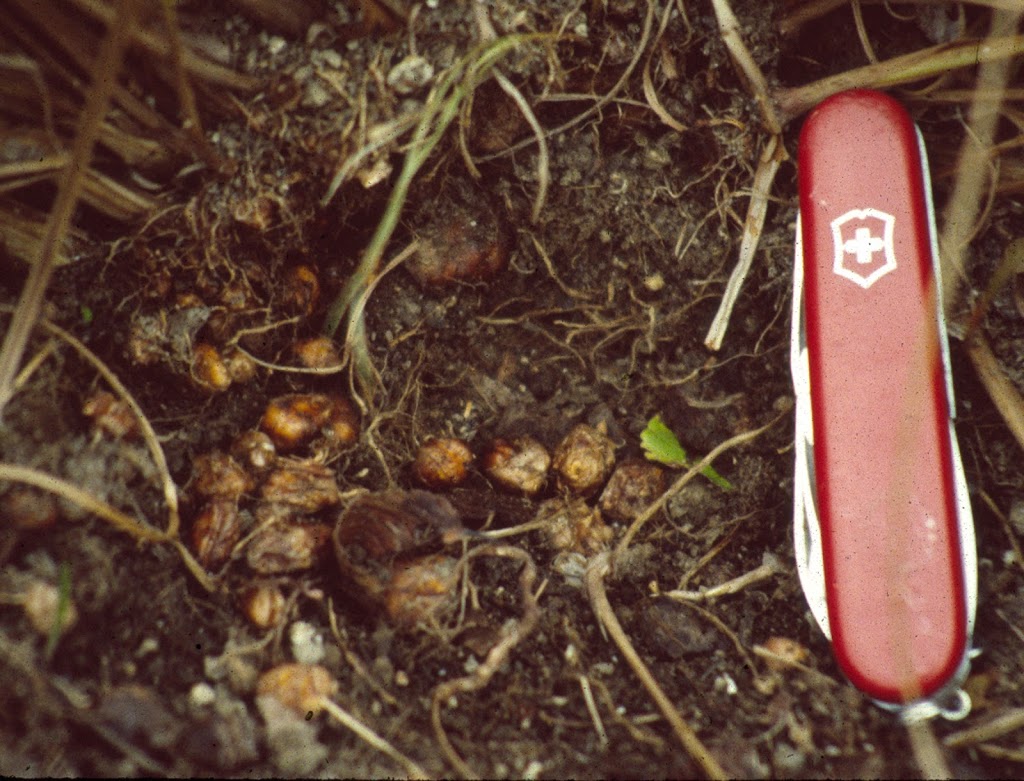
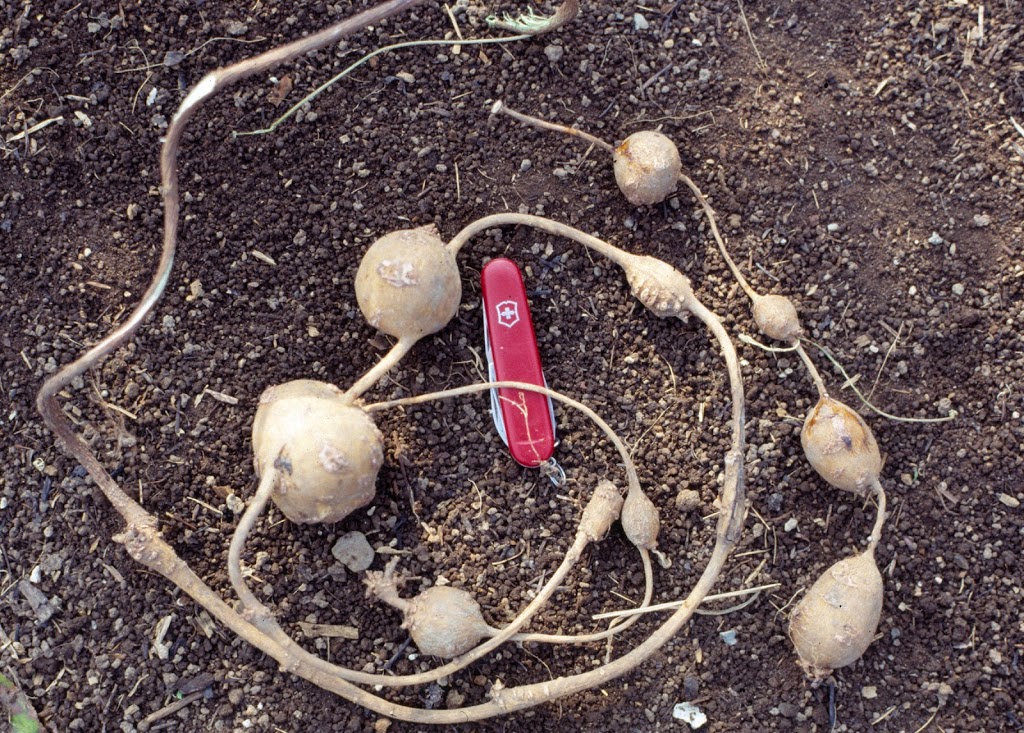
Digging in the flower bed unearthed some golfball-sized tubers connected together like a chain of beads. I immediately recognized them as tubers of Apios americana, sometimes called Indian potato or groundnut (not to be confused with that other groundnut, the peanut). How did I recognize them so quickly? Because I planted groundnuts about 25 years ago!

Groundnuts should be more famous; they are the unsung heroes of Thanksgiving. The Wampanoaga Indians introduced the Pilgrims to this plant, and the Pilgrims’ diet during one of those first winters was supplemented by an Indian cache of groundnuts and corn discovered by Miles Standish. The Pilgrims soon coveted this food for themselves, to the extent of issuing an edict in 1654 ordering that: “if an Indian dug Groundnuts on English land, he was to be set in stocks, and for a second offense, be whipped.”

Native Americans didn’t really cultivate groundnuts, but merely coaxed them along where they grew naturally. Modern Americans became interested in domesticating groundnuts a few decades ago. Hence my groundnuts, sent to me by one of those modern Americans.

Groundnut can be weedy, spreading all over the place via those tuberous chains. I’ve been half-heartedly weeding groundnuts out of my flower bed for 23 years, looking in vain for tubers each time I weeded. Evidently, I didn’t dig deeply enough — until this flower bed makeover.
—————————————————–

Clematis ‘Piilu’
The flower bed is also home to a couple of clematis vines that climb up 5-foot-high wire towers, and beyond. No clematis vines will be touched by a shovel for the makeover, especially since this has been such a spectacular year for those two and other clematis vines I grow. Why this year? Who knows? Clematis are generally winter hardy and not particularly at the beck and call of the weather.

My favorite clematis, named Piilu, arrived here a couple of years ago from Klehm’s Song Sparrow Farm and Nursery (http://www.songsparrow.com/). Piilu grows only about 5 feet high to make a very densely flowering column (with support) of flowers. The flowers have pale lavender petals whose intensity deepens towards their bases, at which also sits a dense bottlebrush of creamy white stamens. The plant blooms all season, with later flowers, borne on new stems, having double rows of petals.
—————————————————–

GROW FRUIT NATURALLY

Every time I go near my apple and plum trees, I feel like my Nanking cherry, mulberry, pawpaw, and persimmon plants are laughing and flaunting their fruits at me. Nanking cherry and company are just a few of the fruits that I grow that require virtually no care.
Apples, on the other hand: If you wanted to come up with the most difficult fruit to grow east of the Rocky Mountains, it would be apple. Or plum, or apricot, peach, nectarine, or sweet cherry. The plants actually grow fine; getting fruit is another story. Organically grown fruit, that is.
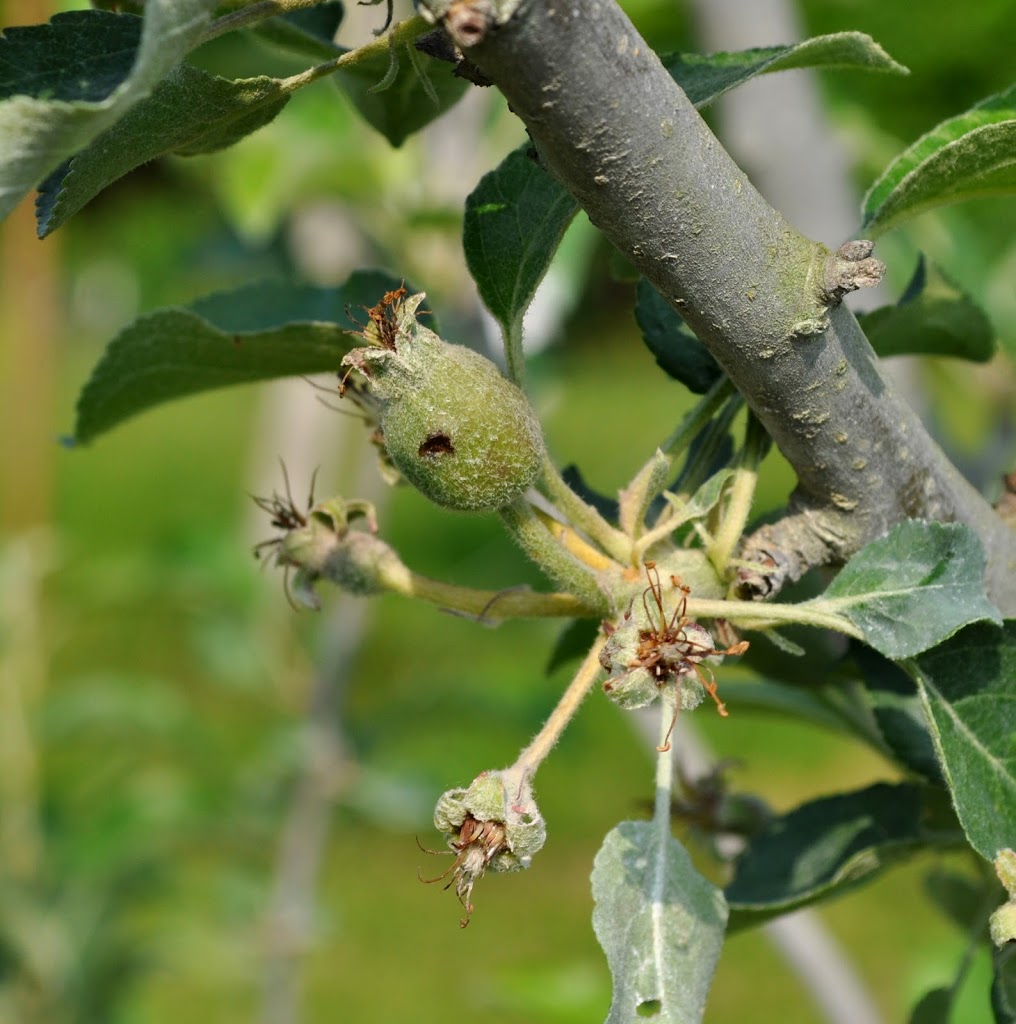
Apple fruit, already damaged by plum curculio
The reason these common tree fruits are so difficult to grow around here is because of insect and disease problems (and, in the case of apricot, peach, and nectarine, winter cold and late spring frosts). For an insect or disease to cause a problem, three conditions need fulfillment: The presence of the insect or disease, a susceptible host plant, and an environment congenial to the insect or disease. I mulch my apples and plums with wood chips, prune away diseased stems, grow nectar-producing flowers to attract beneficial insects, spray organic concoctions such as kaolin clay, let chickens run loose beneath the plants, blah, blah, blah; and for all that effort, still often reap little or nothing. 
Problem is that the northeast is home to some serious insect and disease problems of apples and company and the environment is much to these pests’ liking, as are the plants. Resistant varieties might be resistant to diseases but not insects or to one disease but not another. No variety is resistant to all the insect and disease pests lurking in forest and field.
————————————————
Nanking cherries, no need to spray or even prune!
Still, most people, when they consider growing fruit, think first of apples, and then plums, peaches, and other tree fruits familiar on supermarket shelves. In fact, though, there are a slew of other fruits, many of them, like Nanking cherry and company, very easy to grow. As I point out in my new book, GROW FRUIT NATURALLY (Taunton Press, 2011), the first step in growing fruits naturally/organically/holistically is to select those that are naturally well-adapted to the local climate and insect and disease pressures.
This all-important planning step does not preclude growing many common fruits. Pears, for example, both European and Asian varieties, are relatively easy to grow around here. The trees do need pruning but usually can be grown without the need for any sprays, organic or otherwise. With thousands of varieties, pears alone could round out your larder. I grow about 20 varieties.
Berries are also relatively easy to grow. Pruning is important both for good production and to help keep diseases and insects in check. My berry plantings include raspberries, blackberries, black raspberries, gooseberries (more than a dozen varieties!), red currants, black currants, clove currants, elderberries gumis, seaberries, lingonberries, lowbush blueberries, and, my favorite, highbush blueberries. Pest control? I spray insecticidal soap on my gooseberries once, just as the leaves unfold to kill any imported currantworms that may be starting their leafy feast. I mulch my blueberries late each fall to bury any infected berries that could spread mummy berry disease the following spring. And that’s about it for pest control on all my berries.
Still not enough fruit? Well, there are the mulberries. Not run-of-the-mill mulberries, such as grow wild all over the place. But named varieties — Illinois Everbearing, Oscar, and Geraldi Dwarf — selected for their high quality fruits. And cornelian cherries, an excellent stand-in for tart cherries, except much, much easier to grow. They bloom around the first day of spring yet never fail to set a good crop of fruit. The same can be said for Nanking cherries, a hedge of which lines my driveway and is now yielding many more sweet-tart cherries than I, birds, squirrels, and chipmunks could possibly eat. Total effort involved for all these fruits? None.
And the list goes on: pawpaws, persimmons, hardy kiwifruits, juneberries, grapes . . . so many fruits, so little space. The grapes get bagged to keep insects, diseases, and birds and bay.
(Actually, in my microenvironment, juneberries do not bear well because of various insect and disease problems. The solution? I don’t grow them. But as I wrote, that still leaves plenty of fruits that can be grown easily and without any significant pest problems.)
—————————————————-
So why do I grow apples and plums? I grow them because I frequently write about fruit growing. I grow them to supplement my “book learning” with what I observe “in the field” (in other people’s “fields” also). I grow them because when I apply all the right sprays at just the right time and the weather cooperates and insect and disease pressures aren’t too, too bad and all the stars align just right, I harvest some very tasty apples.
——————————————————–
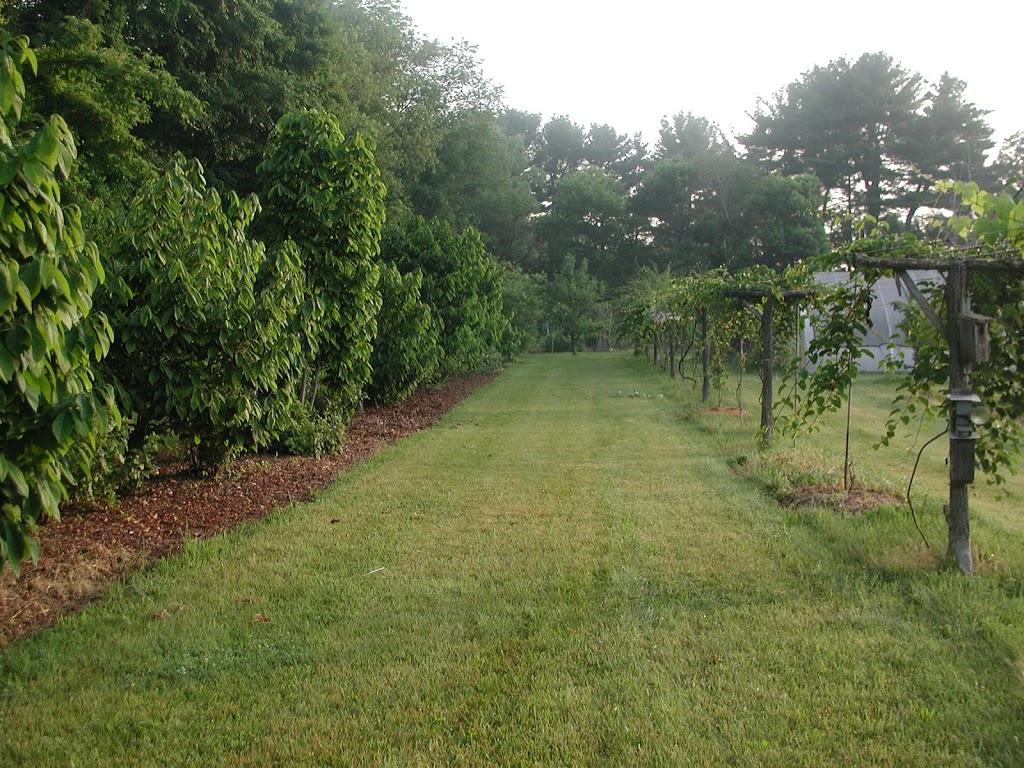
My pawpaws and hardy kiwifruits
Would I suggest others to plant apples, plums, or possibly peaches, apricots, nectarines, or sweet cherries? Probably not, unless said person was interested in learning a lot about fruit pests, spending a lot of time and no small amount of money dealing with them, and then was willing to accept the fact, as Charles Dudley Warner wrote, tongue-in-cheek and over a hundred years ago in MY SUMMER IN THE GARDEN, that “the principle value of the garden . . . is to teach . . . patience and philosophy, and the higher virtue – hope deferred, and expectations blighted, leading directly to resignation, and sometimes to alienation. The garden thus becomes a moral agent, a test of character, as it was in the beginning.” All well and good if that’s what you want from planting fruit.
—————————————————–

CARTS, DAME’S ROCKET, INVASIVES, & ROSES

A garden cart improves any garden, and I’m especially enjoying using my cart, now in its third decade of use. This cart has hauled hay, manure, weeds, and old vegetable plants to the compost bins, and finished compost from the bins to vegetable beds and fruit trees. It’s hauled stones for wall building and heavy locust posts that get notched and bolted together to become arbors and trellises.
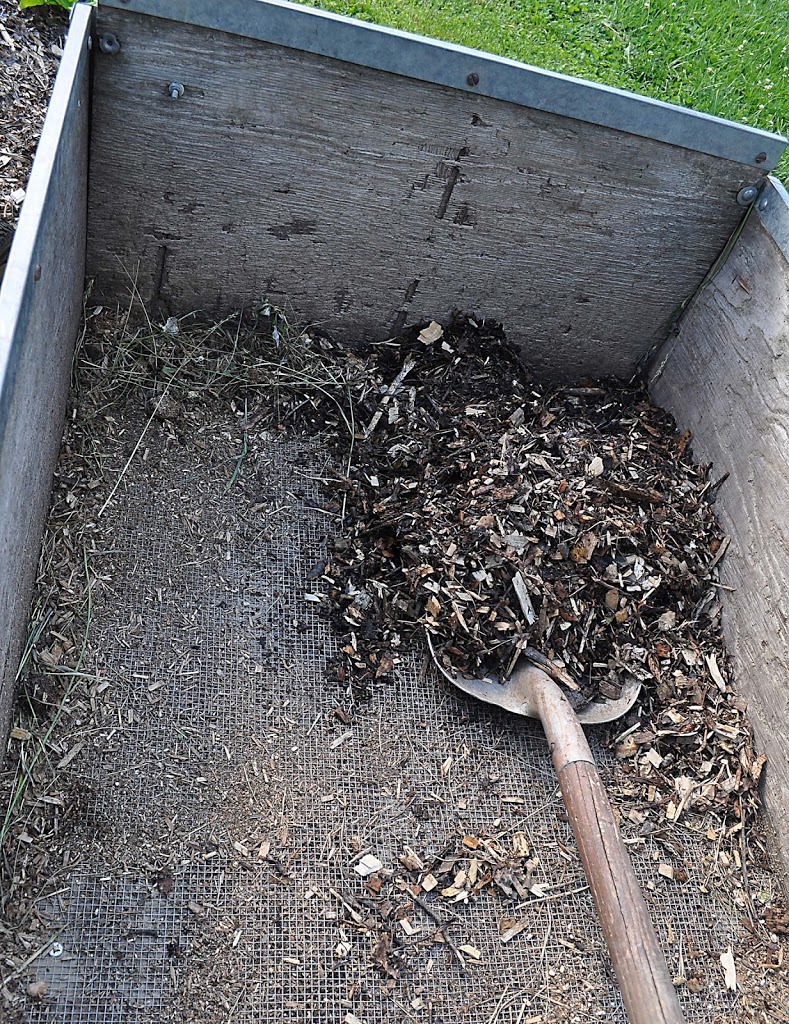
Look closely: Hardware cloth in bed
A good cart has two heavy duty, bicycle-sized tires sitting just about midway across a sturdy plywood bed surrounded by three sturdy plywood walls. Tossed rocks, the scraping of a shovel, and an occasional jab with the pitchfork have eaten away that plywood over the years. Not anymore, and that’s why I’m especially enjoying using the cart.
A few months ago, I decided to replace the plywood bed, which by then had few plies left. Instead of replaying the scenario from the last replacement, about 15 years ago with exterior grade plywood, I used pressure-treated plywood, which is more rot-resistant. And next, to fend off the constant scraping of shovels, rocks, and other tools and materials, I laid 1/4 inch mesh “hardware cloth” over the plywood base and screwed it down.
Today, shoveling wood chip mulch out of the cart to spread around the base of newly planted mulberry trees, no little voice in the back of my mind was reminding me that each shovelful was also scraping off a bit of plywood. I’m expecting to get good mileage with the new bed. Stay tuned; I’ll report back in 30 years.
—————————————————–
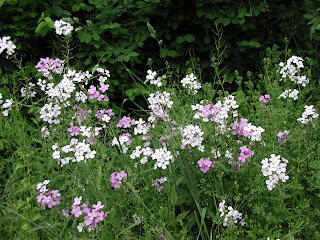
Dame’s rocket (Hesperis matronalis), a wildflower often mistakenly thought to be phlox (which has 5 petals instead of the 4 of dame’s rocket, has put on a great show of white, lilac, and pale purple blossoms this year. Now a dark cloud has passed over those cheery flowers.
Dame’s rocket, a European native that used to be cultivated in American gardens, escaped from our gardens many years ago to invade road sides, meadows, and cultivated fields. In some places, this comely flower is billed as “invasive.” “Left unchecked, this beautiful, yet lethal plant will wreak havoc on the natural environment, threatening the survival of native plants and degrading habitat and water quality,” writes restoration ecologist Steve Apfelbaum.
Call me irresponsible, but I still like dame’s rocket. I welcome it into my flower beds and into my meadow. In addition to beauty, the flower perfumes the air with a delicious, sweet aroma.
I have been too blasé about some other invasive plants in the past. I remember praising garlic mustard for its flavor. What was I thinking? The plant is now all over the place and doesn’t even really taste very good. Garlic mustard gets ripped out of the ground wherever I see it, in and around my garden at least. Perhaps I’ll eventually feel the same about autumn olive, which I enjoy for its fragrant blossoms in spring, its silvery leaves in summer, and the oodles of tasty, small red berries it bears in autumn. Thus far, I find Japanese stilt grass, yet another invader, attractive.
Sweet, pretty dame’s rocket is allegedly going to contribute to the alleged $200 billion of damage for which invasive plants are responsible. It’s even suggested that the plant might have some resistance to the herbicide Roundup.
——————————————————-
The whole invasive plant threat has, in my opinion, been blown way out of proportion. Our landscapes, wild and cultivated, are not — and should not — be static. Over time, extant species might become more or less prevalent and new species might move in.
And just what does “native” mean? A few hundred feet from the alluvial soil of my garden in the Walkill River valley, the ground slopes up sharply to the craggy, rocky outcroppings of the Shawangunk Ridge. Plants native up there, such as mountain laurel, aren’t native down here. Furthermore, research has shown that non-native species sometimes have a positive environmental impact (see, for example, Mark Davis et al in Nature 474, 153–154, 2011).
Obviously, we need to try and control invasive plants, whether they are native or non-native, when they cause intolerable disruption of the environment or threaten our well-being. But change is inevitable and usually not bad. Quoting Michael Pollan, turning the “ecological clock to 1492 [or any other date] is a fool’s errand, futile and pointless to boot.”
—————————————————–
Rose de Rescht
What a great year for roses, even if I’ve always contended that I didn’t like the roses. Actually, I didn’t and don’t like the roses that are most commonly grown, which are hybrid tea roses. The plants are gawky, something you’d plant out of sight just for cut blossoms, and the flowers are stiff, formal, and jarring in color. They’re also very susceptible to all sorts of pests.
William Baffin
I do like the roses I have growing and which are presently drenched with blossoms. The super-hardy William Baffin rose, from Canada is sporting single, large, bright red flowers. Amber Sunblaze is notable for salmon-pink blossoms on a plant whose foliage stays glossy, green, and healthy all summer long. A couple of David Austin rose blossoms look like cupfuls of pastel-colored crêpe paper.
My favorite of all the roses, one given to me as a cutting many years ago by herbalist Ann Solomon, is Rose de Rescht. At least that’s what it’s alleged to be. Rose de Rescht is supposed to have more than one bloom period each season, though, and mine has never rebloomed. Then again, mine never flowered as well as it has this year, a couple of years since I moved it to its new and more congenial surroundings.
Whether or not my Rose de Rescht really is Rose de Rescht, it’s now covered with blowsy, soft pink blossoms that send their fragrance a few feet from the bush. Everyone that smells the blossoms says something to the effect “Now that is a real rose smell.” And the rose blossomed just in time this year to provide abundant flowers for a very special wedding.

PRUNING A LILAC, DEALING WITH APHIDS

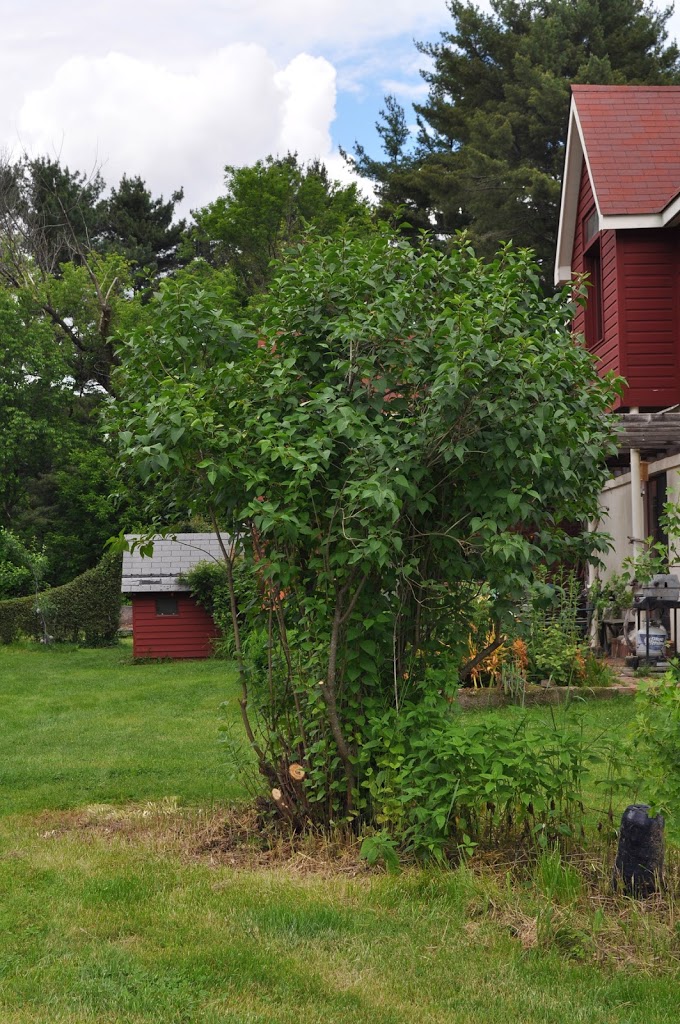
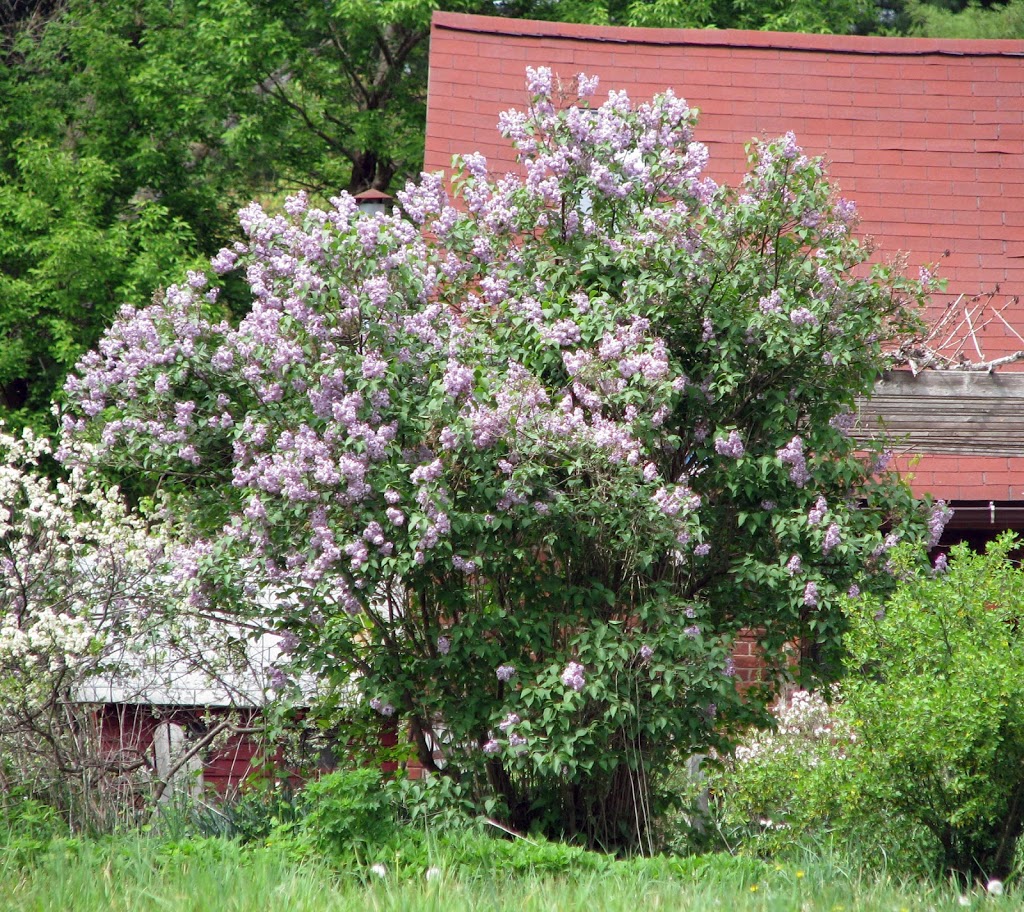
Who would look at a lilac bush, just leaves and flowers morphed to browning seed capsules, and even prune it this time of year? I would! Pruning a couple of months ago would have cut off many blossoms before they even unfolded. Pruning now, after enjoying the blossoms, is a way to keep the shrub shapely and queue up blossoms for next year. Next year’s flowers are formed on buds this summer so we can’t wait too long to prune or there won’t be enough time for the new flower buds to develop.

My lilac has suffered years of pruning neglect (quite an admission from the author of The Pruning Book, especially as relates to a plant that looks best with annual or at least biannual pruning). Every year my lilac has grown uglier and uglier, its flowers fewer and fewer, and the task of pruning it more and more daunting. On the flip side, the plant has been harder and harder to ignore.

So this week I attacked. A scythe made quick work of clearing old daffodil foliage, and weeds from around the base of the plant. Moving on to the bush itself, the most dramatic cuts came first, with a hand saw lopping a few of the thickest stems right down at or near ground level. Other thick stems got less severe treatment. Where branching was making parts of the shrub too dense, I cut off some of the branches. Down at the base of the plant, I thinned out some young sprouts so that those that remained could develop with sufficient elbow room. I also carefully unravelled and cut back as low as could be reached some poison ivy that had insinuated itself in amongst the lilac stems.

My lilac in bloom a few years ago.
The work was slow but worth it. Like building a stone wall, pruning a neglected, old lilac is a job that can’t be rushed. Trimmed, the lilac shrub now rises up from the soil like a graceful fountain of water. Increased light within the shrub and removal of much old wood and developing seedpods should make for a good show next May.
————————————————-

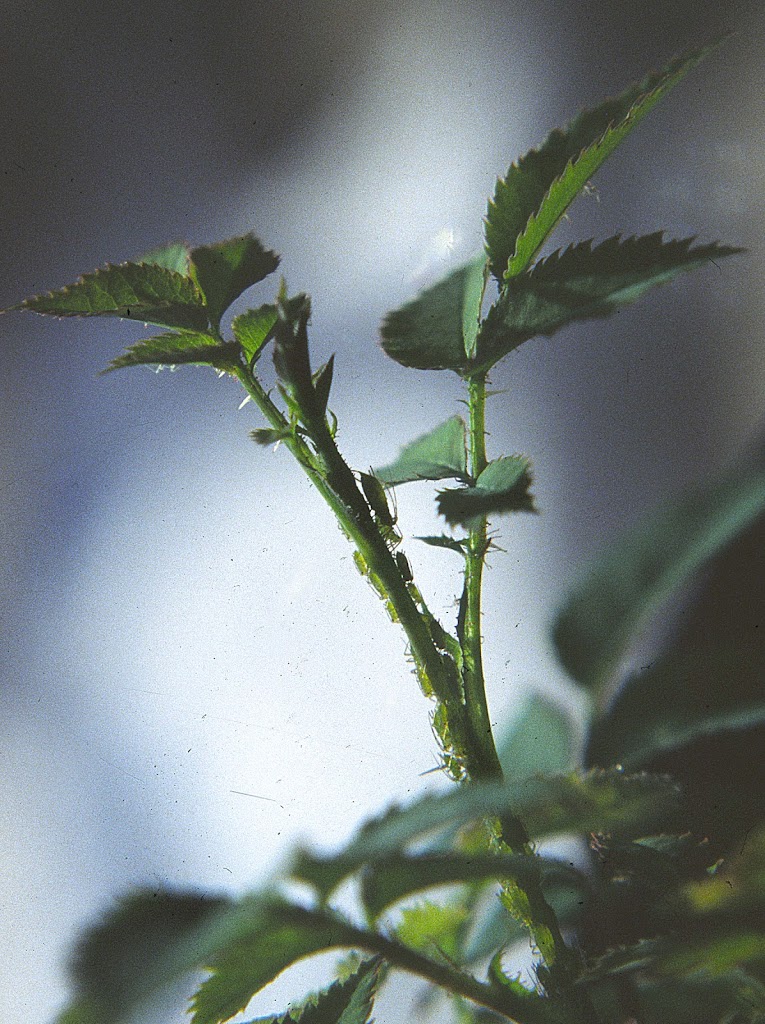
A friend told me that his wife was rather frantic about aphids on some of their shrubs. Yes, aphids are plant pests, but they also are so interesting. For instance, the females — which most aphids that you see are — give birth to live young that are clones of themselves. No males or sex is needed to make those babies. 

Unfettered, a single female could give rise to thousands of offspring over the course of a season, which could result in crowded conditions or having to settle for to poorer quality food. No problem. When that happens, Ms. Aphid gives birth to babies with wings so they can fly off in search of greener pastures. Come autumn, it’s time for some sex. Females then produce a few males, mating occurs, and eggs are laid that remain dormant until spring.

We’re not knee-deep in aphids, so something is keeping aphid populations in check. Cold, heat, and rain all take their toll. Aphids also have many natural predators, including fungi, lacewings, and, most familiarly, ladybird beetles. 

Outdoors, I sometimes see aphids on plants but usually just wait for them to naturally die out. Their most dramatic damage effect is the red puckering they leave on a few red currant leaves. Plants can compensate for some leaf damage; I do nothing and the red currants have always been none the worse for wear. Many pesticides are especially toxic to aphid predators and I credit much of my lack of aphid problems to my avoidance of pesticides.

But my friend said aphids were killing his shrubs. He sprayed horticultural oil, a light oil formulated to smother pests but not damage plants. That’s a reasonable and benign strategy, effective if the spray thoroughly coats the plant. Other environmentally sound sprays are insecticidal soap or — my favorite — strong blasts of water. On small plants, aphids, which mostly congregate on new growth, can be merely rubbed off with your fingers.

My friend asked about buying in some ladybird beetles. That works, if the ladybird beetles stick around. Green lacewings are another aphid predator that can be purchased. An often more effective and cheaper alternative to buying in aphid predators is to create habitats that attract them. At some points in their life cycles, many predators feed on plant nectar, which is especially abundant in small, wide-opening flowers such as cilantro, dill, coneflower, coreopsis, alyssum, goldenrod, cosmos, sunflower, and other members of the carrot or daisy family.

This year is the first year that I see no evidence of aphid attack on my red currants. My guess is that the late frosts did in the buggers.
———————————————

I’d rather not have had those frosts and had more aphids because those frosts also knocked out some developing fruits. Hardest hit were apples, Asian pears, European pears, and hardy kiwifruits. Least affected were grapes and super-hardy kiwifruits, both of which fruit on secondary buds if primary buds are killed, persimmons, pawpaws, blueberries, raspberries, blackberries, gooseberries, and black, clove, red, pink, and white currants. A variety of plants is a good hedge against bad weather and other calamities.
—————————————————–

Another WORKSHOP: BACKYARD COMPOSTING. The why and the how of backyard composting, everything from designing an enclosure to what to add (and what not to add) to what can go wrong (and how to right it). Also, how to make best use of compost. Workshop will be held 9-11:30 on June 23rd at my farmden. Space is limited. Contact me for registration or other information.

BAMBOO & GARLIC GONE WILD

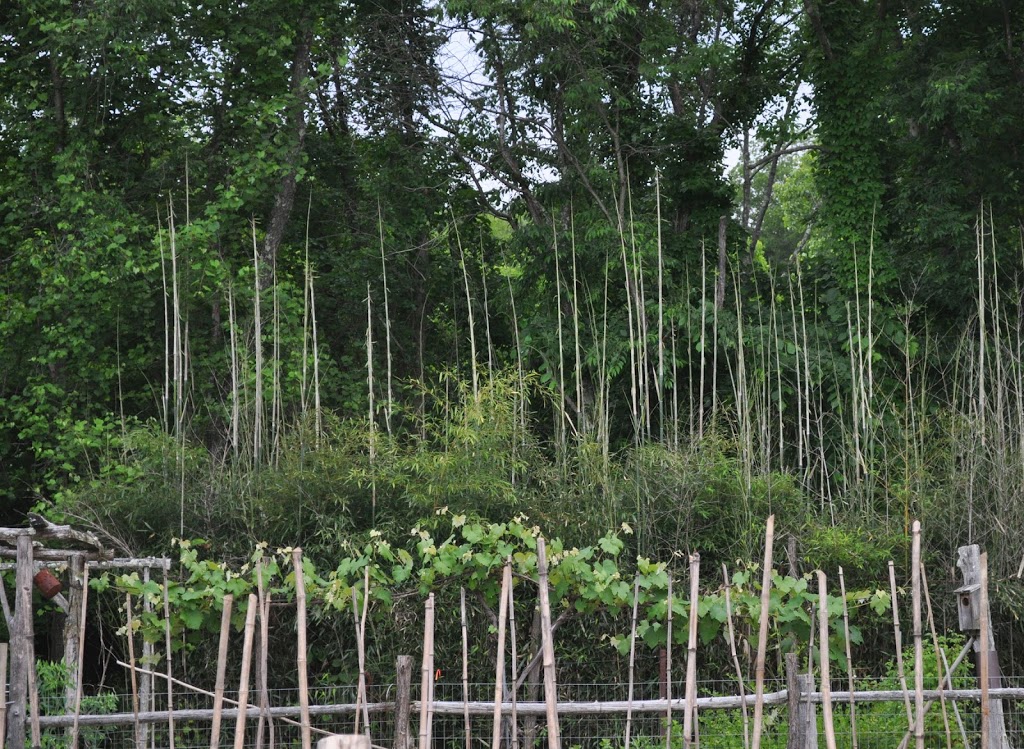
Bamboo is a plant that can strike up admiration as well as terror. Right now, my planting is leaning towards terror.

Most cold hardy bamboos are so-called running types for their ability to spread via underground runners. A few hardy bamboos behave like tropical bamboos, forming neat clumps whose spread is hardly noticeable. These cold-hardy temperate kinds (Fargesia spp.) have relatively thin canes that create picturesque, delicate-looking fountains of greenery. 

But 20 years ago I wanted (and still want) bamboo with robust canes thickening to an inch or more across, a bamboo on which can climb tomato or bean plants, that I can use for making trellises, even for eating. And the grove itself, with some pruning out of crowded canes, becomes a mysterious forest.

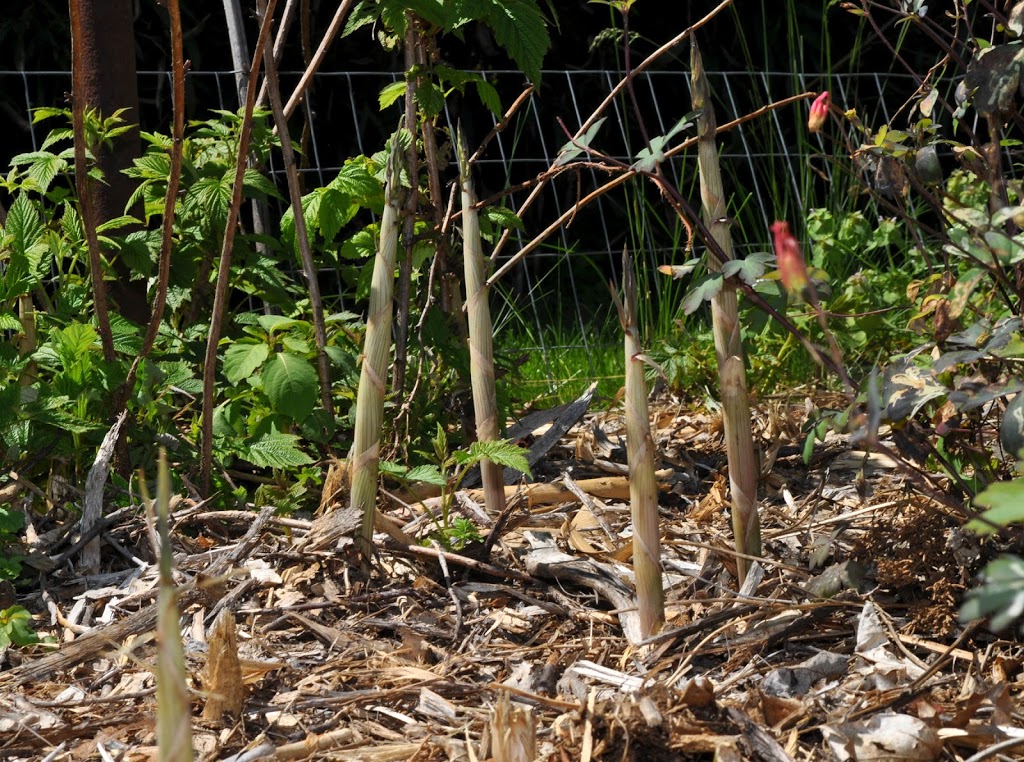
This spring’s new growth of bamboo towering above last year’s.
Yellow grove bamboo (Phyllostachys aureosulcata) is among the hardiest of the “timber” bamboos. Within a half-hour’s drive from here, into cold hardiness Zone 6, this species grows over 20 feet tall, with 2-inch-thick canes. In this cold spot where I live, yellow grove bamboo grows only about 15 feet high, with canes just a little more than an inch across — nice, but not quite as “mysterious” or “foresty” as I had hoped. Except for recent winters, the canes of my planting have always died back to the ground so that each year the plant had to grow all new canes, something it does with much enthusiasm. I’ve measured 6 inches of growth per day for the month or so it elongates in spring!

In recent winters, my planting has held its green leaves all through winter, just like plants further south. The result is thicker and longer canes. That extra energy saved also infuses the whole planting with even more vigor — and that is what incites terror.

I had the foresight 20 years ago to hem in most of my planting with an impenetrable barrier to stop the future spread of the roots. The thick plastic barrier reaches down a couple of feet deep into the ground and is usually used to prevent tree roots from creeping beneath and heaving up nearby sidewalks.

I lacked the foresight 20 years ago to appreciate how relentlessly the roots would seek escape from said barrier. Some roots evidently briefly braved sunshine long enough to hop over the lip and then dive back into the ground, reappearing across an 8 foot strip of mown grass in among some raspberry and gooseberry plants. My plan for the latter escapees is to cut down shoots as relentlessly as they appear, and eat them. And then, close inspection of the barrier and severing of errant escapees right there should starve out the root network that has entered the garden.

I never put a barrier to the rear of my planting. There, woods have pretty much kept the spread of bamboo roots in check. But with warmer winters, less so in recent years.
——————————————-
I just don’t get all the hubbub about garlic. I was recently looking at a friend’s very small vegetable garden, almost half of which was devoted to garlic. It’s not that garlic tastes bad (although in the past it was used more as medicine or for warding off witches than for eating). It’s just that the area devoted to garlic could have been devoted to asparagus, tomatoes, lettuce, or beans. Even small fruit bushes, such as gooseberries, currants, or blueberries could have used that real estate instead. 

I’d choose any of these vegetables or berries over garlic (for eating, not sorcery). Home-grown asparagus, tomatoes, lettuce, or beans taste vastly better than what you can buy. Same goes for the berries, and you can’t usually even buy gooseberries or currants, especially of the better varieties. Garlic from a store or farmer’s market tastes as good as what you can grow, and fresh-picked is not a consideration for this storage bulb.

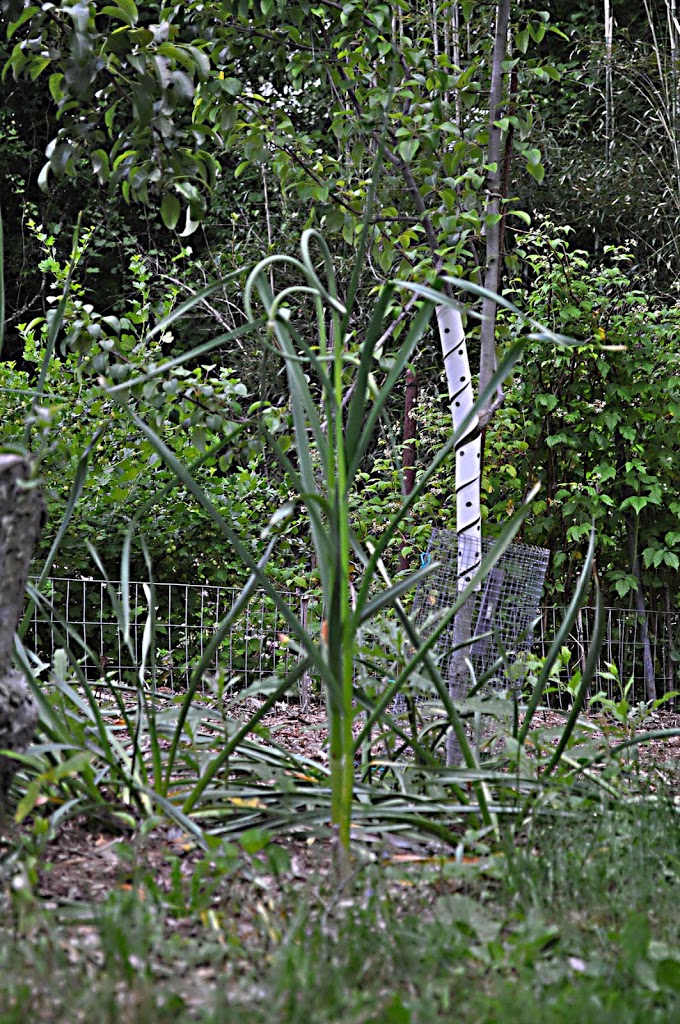
I grow garlic as an afterthought in out of the way places. It does get its needed full sunlight and rich soil, though. In fact, around here, I spend more time weeding out garlic than planting it. Clumps sprout in my flower beds, in amongst my berry bushes, and at the base of a rose bush. Garlic does not make seeds so I can’t imagine how it gets to all these places.

I’m glad that the one place where it does not appear spontaneously is in my vegetable garden.
——————————————————–

RICE IN THE NORTHEAST, GARDEN GATES

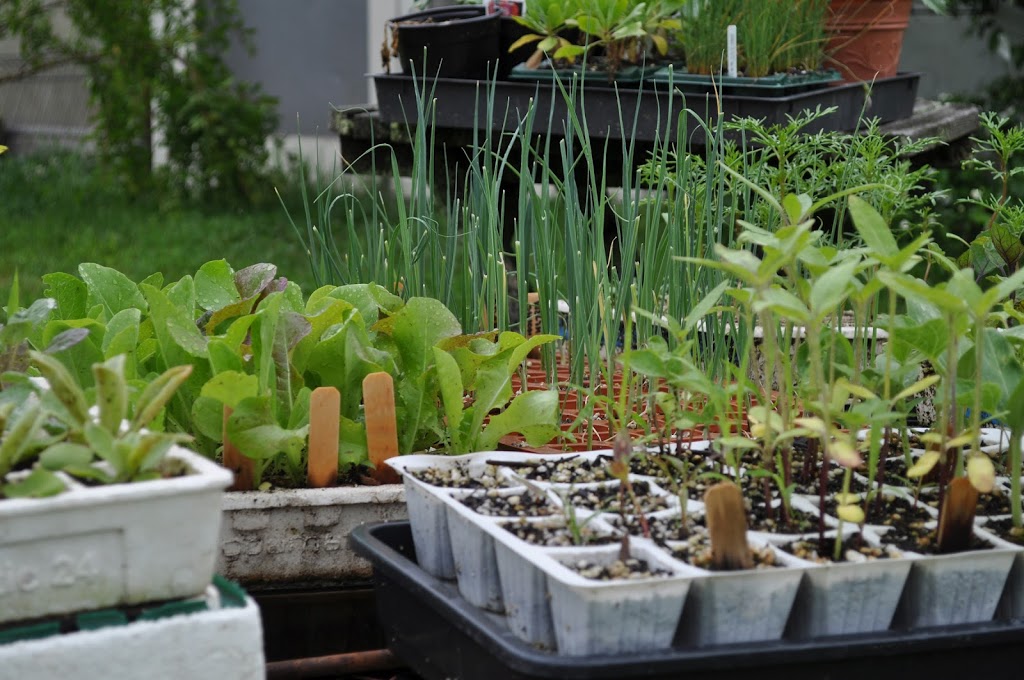
Here I am swimming in seedlings and small, potted plants sitting on shelves or the ground in the greenhouse, on my picnic table, and on the terrace. Each plant is waiting for the right time to be planted outdoors or to be moved to a bigger pot. So why would I add to the crowd by planting something as absurd as rice? Because rice tastes good and might be fun to grow.
Interest in commercial and home rice cultivation has been on the rise here in the northeast, as attested to by last year’s Second Annual Northeast Rice Conference, held in  — of all places! — Vermont. No paddies in the works here; I’m parting ways with most of my fellow growers in planning to grow rice under dryland conditions. Growing rice in flooded fields is a useful way to snuff out weeds — dryland weeds, at least — and, more importantly, in northern regions, to moderate temperatures. My planting is going to be very small, measured in square feet, so I can weed by hand, and my site is considerably warmer than anywhere in Vermont.
My planting has to be small because I’m starting with very few seeds: the variety Hayayuki, generally recommended for northern conditions and kindly shared with me by Ben Falk (www.wholesystemsdesign.com). Ben has grown rice successfully in paddies he constructed at his homestead in central Vermont.
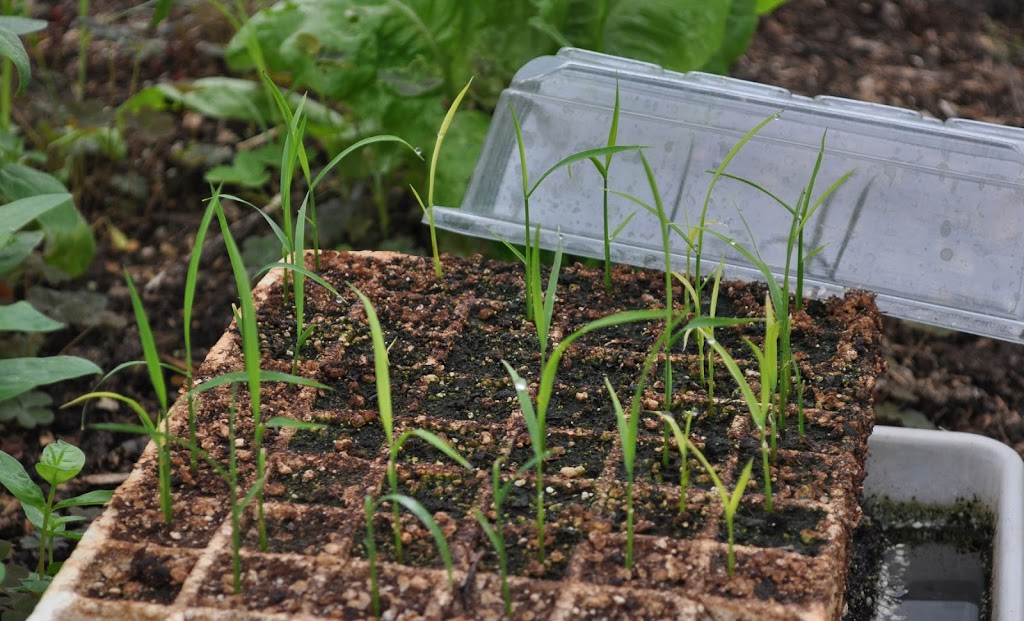
So today I planted seeds in a seedling tray with inch square cells in each of which I planted one or two seeds. If everything goes as planned, I’ll be transplanting in a few weeks (rice does not tolerate any frost, doesn’t even like cold weather). Recommended spacing is 12 x 8” for groups of 2 to 3 plants. My garden soil is very rich so I’ll plant closer than recommended. Harvest, with a grass shear, should come in September, followed by threshing by smacking pillowcase-filled seed heads against the floor. As for dehulling the rice, that is, removing the hard coat around each kernel . . . I’ll cross that bridge when I get to it. Plans for a small-scale dehuller are available at http://www.savingourseeds.org/pdf/grain_dehuller.pdf
———————————————
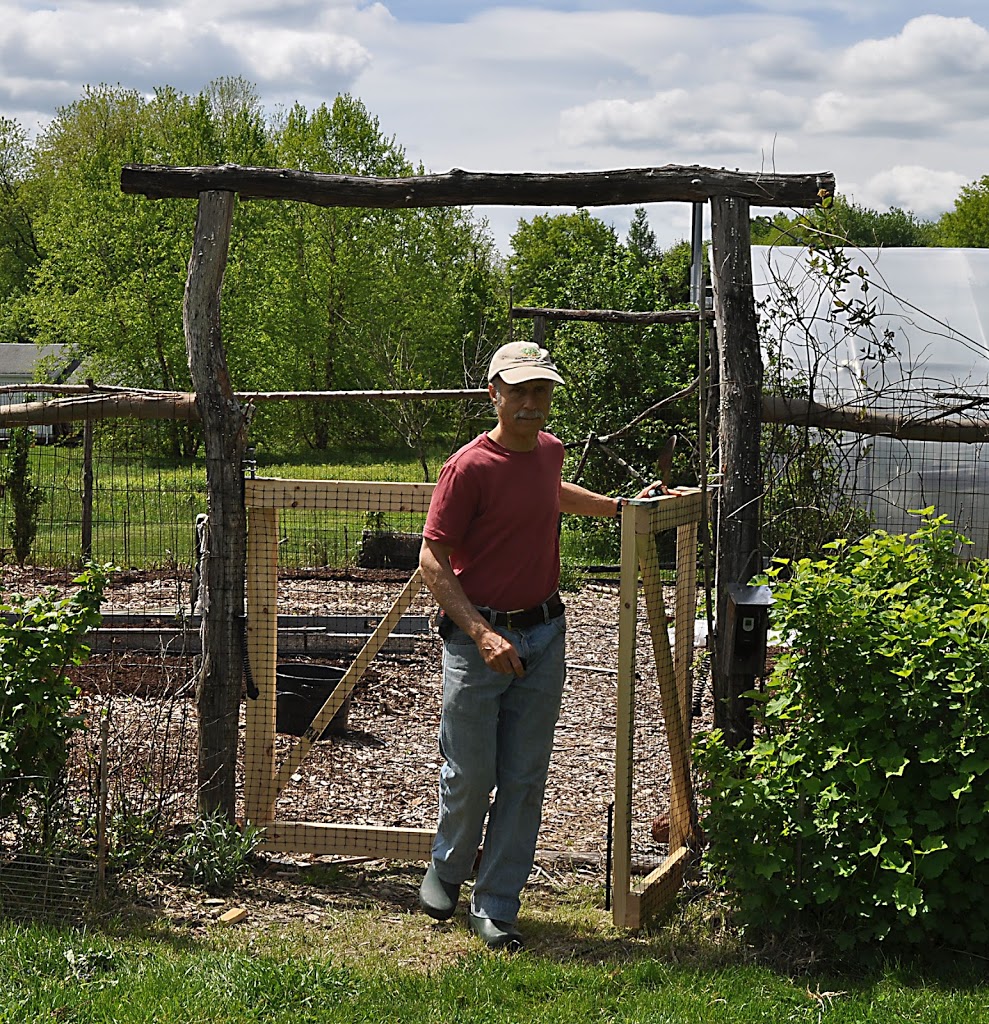
Moving on to more practical matters: gates. If good fences make good neighbors, good gates make good invitations to pass through fences. The gate to my south vegetable garden is not good. It was when I built it, the sturdy frame of natural locust wood swinging either open or closed with the mere touch of a finger.
But locust wood is heavy, and that weight was the gate’s downfall, literally. For the past few years, the bottom scraped along the ground so that lifting the handle was necessary to open and close it. A five-foot span hinged at one end put too much stress on the wood.
I realized recently that the extra trouble of opening the gate and the possibility of it breaking was was limiting trips into the garden. And there’s little worse for a vegetable garden than a disincentive — be it distance, too many weeds, or a gate that’s too hard to open — to enter it.
That full five foot breadth was only necessary to let pass the occasional garden cart full of compost to spread over the beds. So why not, methinks, rebuild the gate with two half gates, one of which would be plenty wide for passing through for the almost daily planting, weeding, and/or harvesting. With less leverage, a half-width gate would experience little stress.
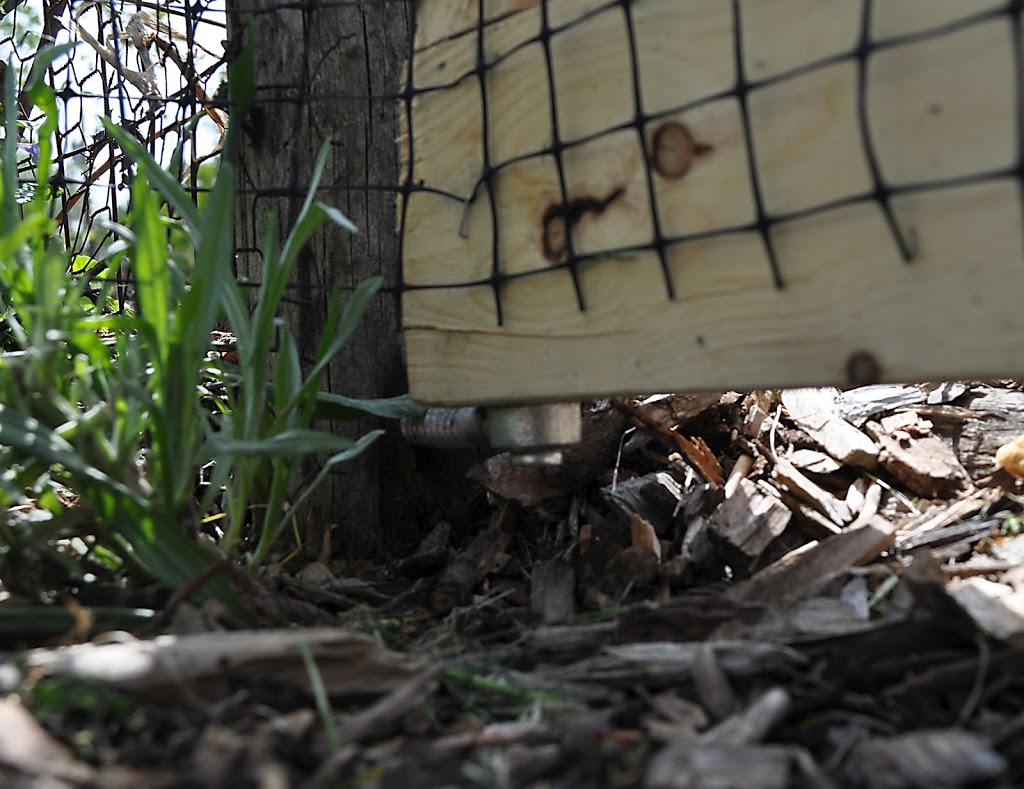
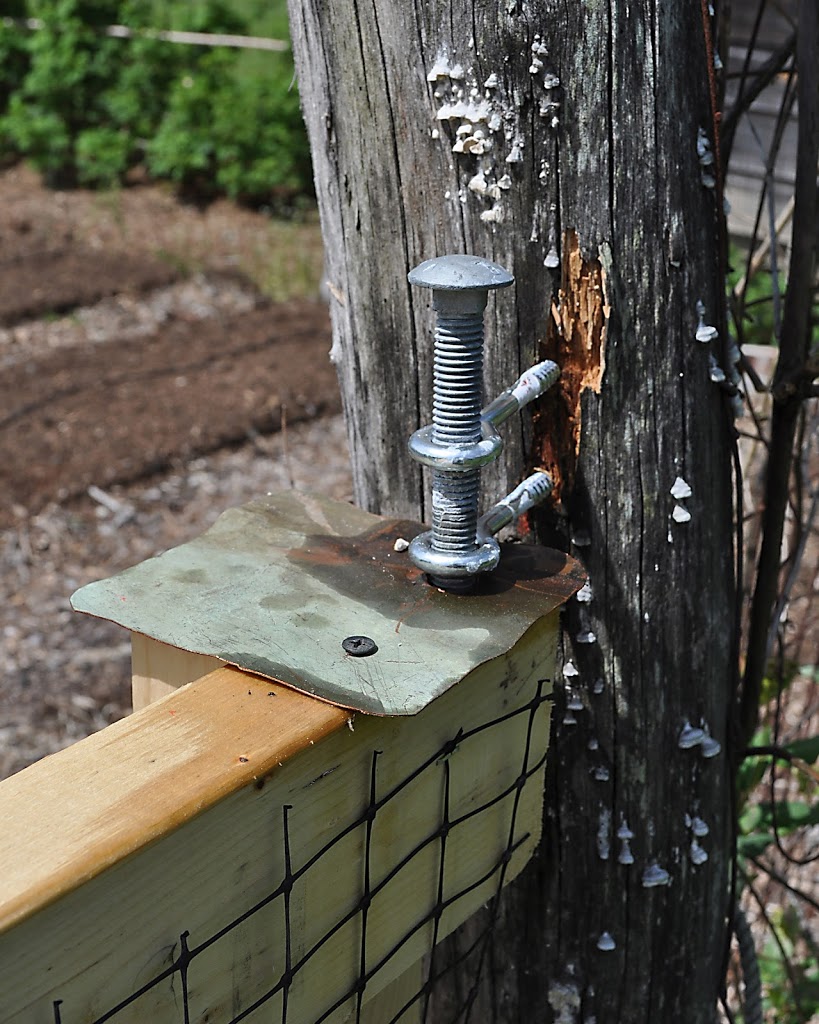
The locust branches of the old gate made it charming but slow to build. I built the new gate — a temporary one — out of 2 by 4s. A pintle sticking up into a hole in the bottom and a bolt sliding down through two parallel eye bolts and then into a hole in the top together make a sturdy, effective, and adjustable hinge, so each gate swings easily and, with a spring closure, shuts automatically.
Already, the garden beckons me. Beds have been layered with compost, weeds have been pulled, and today I’ll sow popcorn seeds. The only problem is that “temporary” building projects too often morph into things more permanent. Two compliments on the new gate have already started it down that road. 
———————————————–

Gardenias, Good books, and Spring Freeze

If I might brag a bit . . . It’s been just over a couple of years that, in the same breath and on these very pages, I bemoaned the loss and decided to again take up the challenge of growing gardenia. I purchased a new one, with which I now claim success. My plant is bushy with lush, glossy green leaves, nine creamy white blossoms are fully open, and buds foreshadowing more are on the way. Fragrance from each blossom is heavenly sweet.


Gardenia is a temperamental plant, ready to be attacked by scale insects, ready to drop its flower buds, and ready to let its leaves yellow and drop. For the scale insects, I sprayed the plants weekly at the end of last summer with a “horticultural oil” spray before cold weather creeping onwards ushered the plant indoors. This benign spray smothers the insects. I kept the plant on a sunny shelf next to my desk where I could keep a close eye out for the insects and when they started to appear in late winter, I sprayed the plant with Safers Soap.


I avoided leaf yellowing by using an acidic potting soil and with regular feeding using a water-soluble fertilizer, again beginning in late winter. Except for a few weeks of yellowing leaves, probably because the leaves were getting old (even evergreen leaves eventually get old, yellow, and drop), the leaves remained healthy and attached. I’ve never experienced drop of flower buds even though gardenias allegedly do so if moved to a different window or given any other slight change in conditions.
I credit most of my gardenial success to keeping the potting mix consistently moist. And, although I checked the soil often, I credit most of that consistent moisture to an automatic watering device I described two years ago. To quote myself, the device is “a porous, hollow spike, the pointed end of which gets pushed into the soil while its opposite, open end fits to a [thin] plastic tube the end of which sits in a jar of water. As the soil dries out, it sucks moisture out of the porous spike which, in turn, draws it in from the reservoir via the plastic tube.” It’s sometimes sold as a “Water Siphon” but also parades under such names as “Blumat,” “Hydrospike,” and “Ceramic Watering Probe.”
————————————————–


Now is the time to get hands dirty in the garden rather than to read about gardening. Nonetheless, 3 gardening books that crossed my desk are so noteworthy that they’re worth a look even now.


Marijuana Pest and Disease Control by Ed Rosenthal might raise a few eyebrows, but if I hadn’t already done my research and had experience with scale insects on my gardenia, Ed’s book would have been most useful. Marijuana is attacked by aphids, mold, fungus gnats — that is, by many of the same pests and diseases that attack our other plants, making Ed’s book a useful general guide to common pests and diseases. Because you don’t want to be smoking poison, the controls are organic.


Moving on, everyone knows the ecological nightmare that mowing, watering and pest and weed control can make of the average lawn. One attractive way to avoid the nightmare is to make your lawn smaller and let part of it become a meadow. Imagine the crisp edge of an expanse of mown lawn rising up to a sea of wildflowers and taller growing grasses with a mown path beckoning you to come within. Catherine Zimmerman’s Urban & Suburban Meadows is one of the clearest expositions for creating a meadow. With many photos and straightforward text, she leads the reader from ground preparation to planting to maintenance, also including plant lists and sources for supplies, plants, and further information. If I didn’t already have a meadow (entered via a meandering, mown path) and didn’t already have the book, I would buy it.


And finally, for a good read, there’s Margaret Roach’s And I Shall Have Some Peace There: Trading in the Fast Lane for My Own Dirt Road, a very engaging account of how Margaret traded in her job as editorial director for Martha Stewart Living Omnimedia for full-time life in her once-weekend home in rural Columbia County. The book is funny, open, and informative but, best of all, very well written. And Margaret has been a knowledgeable gardener for decades.
————————————————


Last night’s (April 29th) low of 26°F was, I hope the last freeze of this season. Hardy kiwi fruit vines awoke blackened and forlorn although I’m still not totally discounting the possibility of a crop from buds still to open. Many pear fruitlets are blackened within, dead. Apples look okay and, of course, pawpaws, berries, and persimmons are also okay. 
Vegetables are easy! Any sort of covering thrown over them provides ample protection.


The last spring frost around here is, on average, shooed out the garden gate around the middle of May so I should not be surprised if another frost sneaks back in some night in the next two weeks.